Elisha Adair was the son of Joseph Adair, Jr. He was my 5th Great-Grandfather. In the 1820 Census, his household is listed as having 10 enslaved people, so he was probably living well at that time.
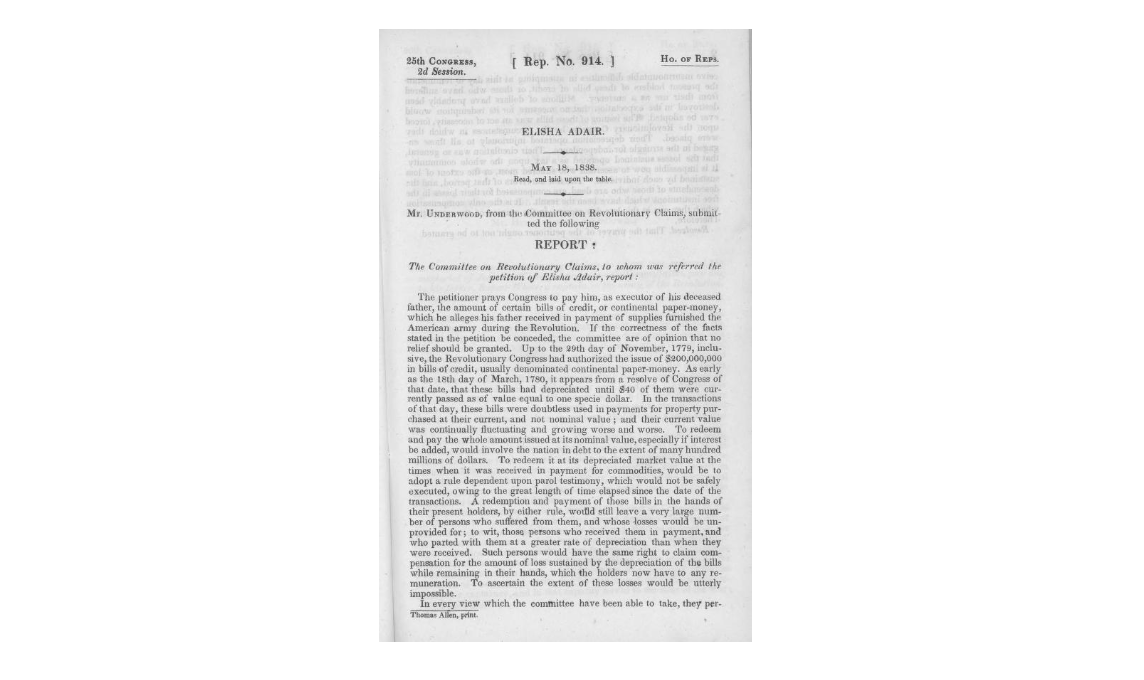
Although it is documented that Joseph Adair, Jr., the subject of this request to Congress, served as Deputy Commissary of the Little River Regiment, there is no pension record for Joseph Jr, only Joseph Sr. From the looks of the request below, Joseph Jr. was never fully compensated to the families’ satisfaction.
25th Congress,
2d Session.
Rep. No. 914.
Ho. of Reps.
ELISHA ADAIR.
May 18, 1838.
Read, and laid upon the table.
Mr. Underwood, from the Committee on Revolutionary Claims, submit
ted the following
REPORT
The Committee on Revolutionary Claims, to whom urns referred the
petition of Elisha Adair, report:
The petitioner prays Congress to pay him, as executor of his deceased
father, the amount of certain bills of credit, or continental paper-money,
which he alleges his father received in payment of supplies furnished the
American army during the Revolution. If the correctness of the facts
stated in the petition be conceded, the committee are of opinion that no
relief should be granted. Up to the 29th day of November, 1779, inclusive, the Revolutionary Congress had authorized the issue of $200,000,000
in bills of credit, usually denominated continental paper-money. As early
as the 18th day of March, 1780, it appears from a resolve of Congress of
that date, that these bills had depreciated until $40 of them were cur
rently passed as of value equal to one specie dollar. In the transactions
of that day, these bills were doubtless used in payments for property pur
chased at their current, and not nominal value and their current value
was continually fluctuating and growing worse and worse. To redeem
and pay the whole amount issued at its nominal value, especially if interest
be added, would involve the nation in debt to the extent of many hundred
millions of dollars. To redeem it at its depreciated market value at the
times when it was received in payment for commodities, would be to
adopt a rule dependent upon parol testimony, which would not be safely
executed, owing to the great length of time elapsed since the date of the
transactions. A redemption and payment of those bills in the hands of
their present holders, by either rule, would still leave a very large num
ber of persons who suffered from them, and whose losses would be un
provided for; to wit, those persons who received them in payment, and
who parted with them at a greater rate of depreciation than when they
were received. Such persons would have the same right to claim com
pensation for the amount of loss sustained by the depreciation of the bills
while remaining in their hands, which the holders now have to any re
muneration. To ascertain the extent of these losses would be utterly
impossible.
In every view which the committee have been able to take, they perceive insurmountable difficulties in attempting at this day to remunerate
the present holders of these bills of credit, or those who have suffered
from their use as a currency. Millions of dollars have probably been
destroyed in the expectation that no measure for its redemption would
ever be adopted. The issuing of these bills was an act of necessity, forced
upon the Revolutionary Congress by the circumstances in which they
were placed. Their depreciation operated injuriously to all those en
gaged in the struggle for independence. Their circulation was so general,
that the losses sustained operated as a tax upon the Avhole community.
It is impossible now to ascertain who suffered most, or the extent of loss
sustained by each individual. The few survivors of that period, and th®
descendants of those who are dead, are compensated for their losses in the
free institutions which have been the result. It is the only compensation
which they can at this late day receive, in the opinion of the committee
Therefore,
Resolved, That the prayer of the petitioner ought not to be granted.
United States Congress. House. Committee On Revolutionary Claims, Joseph Rogers Underwood, Publisher United States Government Publishing Office, and Author United States Congress. House. Elisha Adair. Read, and laid upon the table. [Washington, D.C.: U.S. Government Printing Office, 1838] https://www.loc.gov/item/2024762663/