Revolutionary War Sites of Laurens County
A Site Guide
Little River District (Laurens County), South Carolina, 1775–1781
Most of the Revolution in the Little River District was fought at small places: blockhouses on the Indian line, fortified plantation houses, mill-seat camps, fords, and a spring by a church. Some sites are marked, some survive only as a sentence in a pension file, and at least one, Fort Ridgeway, has never been found.
This guide lists them in the order the war reached them. Each entry gives what happened there, how good the evidence is, where the marker stands, and a link to a full page where one exists.
How to read this guide. ⚠ marks a fact that is disputed or weakly sourced. “LLL” is the Laurens County Museum’s Life, Liberty, Laurens website. Its pages are excellent for markers and directions but give no citations, so where a fact rests on LLL alone we say so.
Site types: 🏰 Fort / Blockhouse · ⚔ Battle · ⛺ Camp · ⛪ Church / Meeting place
On This Page
- At a Glance
- 1. Hollingsworth’s Mill
- 2. Lindley’s Fort
- 3. Kellett’s Blockhouse
- 4. Blockhouses on “the Indian Line”
- 5. Williams’s Fort
- 6. Hammond’s Old Store
- 7. Fort Ridgeway
- 8. Hayes Station
- 9. Liberty Spring
- Open Questions
- Visiting
At a Glance
| # | Site | Type | Date | Full page |
|---|---|---|---|---|
| 1 | Hollingsworth’s Mill | ⛺ | Dec 1775 | — |
| 2 | Lindley’s Fort | 🏰⚔ | 15 Jul 1776 | Lindley’s Fort |
| 3 | Kellett’s Blockhouse | 🏰⚔ | 1776–1781 | — |
| 4 | Indian-line blockhouses | 🏰 | 1777–78 | — |
| 5 | Williams’s Fort | 🏰⚔ | 31 Dec 1780; 2 Mar 1781 | Durant’s essay |
| 6 | Hammond’s Old Store | ⚔ | 30 Dec 1780 | Hammond’s Old Store |
| 7 | Fort Ridgeway | 🏰⚔ | 3 or 5 Sep 1781 | Fort Ridgeway |
| 8 | Hayes Station | 🏰⚔ | 19 Nov 1781 | Hayes Station |
| 9 | Liberty Spring | ⛪ | tradition | Durant’s essay |
1. Hollingsworth’s Mill ⛺
The Snow Campaign camp, December 1775
The Patriot army of the Snow Campaign, under Col. Richard Richardson, camped at Hollingsworth’s Mill on Rabon Creek. LLL says about 4,000 North and South Carolina militia assembled there. On 22 December 1775, Lt. Col. William “Danger” Thomson led a flying column of 1,300 men from this camp against the Loyalist Capt. Patrick Cunningham at the Great Cane Brake. The two-foot snowfall that named the campaign caught the army in camp here at Christmas 1775.
Two Laurens-company captains served in the campaign: Capt. James Williams of Little River and Capt. Robert McCreary of Duncan Creek.
Dates: the army crossed below Levi Casey’s plantation on Duncan Creek on 12 December 1775, sent Thomson’s column out on 22 December, and was in camp here on Christmas Day.
Site / marker: where Dirty Creek meets Rabon Creek, near the Ekom Beach Rd crossing. The marker is at 1700 Fort Lindley Rd, Laurens, alongside the Fort Lindley marker.
Read more: The Battle of Great Cane Brake · Commentary on the Site of the Battle of Great Cane Brake (Durant Ashmore)
Sources: Duncan 1999, p. 15; LLL, “Hollingsworth’s Mill”.
2. Lindley’s Fort 🏰⚔
15 July 1776
A private stockade on Rabon Creek, probably built during the Cherokee troubles of the early 1760s.
The attack: around midnight on 15 July 1776, about 190 attackers struck the fort: 88 Cherokee and 102 Loyalists disguised as Cherokee, with David Fanning among them. Maj. Jonathan Downs and about 150 men of the Little River Regiment were defending some 50 settlers sheltered inside. After a two-hour fight the defenders charged out of the gates, and the attackers withdrew before dawn. Thirteen were captured and sent to the Ninety Six jail. LLL calls it “the first significant Cherokee offensive of the Revolutionary War.”
Site / marker: 1700 Fort Lindley Rd, Laurens, on private property. It is one of the few sites in the county whose exact location is known (National Register nomination, 1977).
👉 Full page: Lindley’s Fort
3. Kellett’s Blockhouse (“Killet’s Station”) 🏰⚔
South Rabon Creek
Built by Joseph Kellett with his neighbours: a square log blockhouse with loopholes, inside a palisade. LLL calls it a “sister fort” to Fort Lindley and says Kellett supplied provisions to Patriot forces. The heritage site says it was built about 1778.
But it was already a named station by late 1776. Samuel Ridgeway (S4119) was “discharged about the first of December … at a place called Killet’s Station” by Capt. James Harvey. ⚠ That date depends on Samuel’s own memory.
Garrisoned in 1780 by Capt. Benjamin Kilgore’s company, per Robert Templeton’s pension (S32550), which spells it “Callets.”
Battle of 3–4 September 1781: fought overnight, after which the Tories burned the blockhouse. LLL counts seven recorded incidents in the area involving Native Americans, Loyalists and British. ⚠ No source is given for either claim. The same night, Capt. John Ridgeway’s blockhouses were taken; see Fort Ridgeway.
Site / marker: 600 Knickerbocker Rd (S-30-308), Fountain Inn, about 34.6112 N, 82.2232 W. The “Joseph Kellett’s Revolutionary War Block House Memorial Bridge” crosses South Rabon Creek there. Kellett, his wife and several sons lie under uninscribed fieldstones in the cemetery.
Sources: S4119; S32550; laurenscounty250.com (28 Mar 2022); LLL, “Kellett’s Blockhouse”.
4. Blockhouses on “the Indian Line,” 1777–78 🏰
Unnamed
John Ridgeway Jr. (S21947) helped build “a blockhouse on the Indian line” in fall 1777 under Capt. John Rodgers. In January 1778, under Capt. James Millwee, he was stationed at “a Block House on the Indian Line.” ⚠ Neither is named, so we don’t assume either one is Kellett’s.
5. Williams’s Fort 🏰⚔
Col. James Williams’s plantation, “Mount Pleasant”

The fall of the fort, 31 December 1780
Loyalists under Brig. Gen. Robert Cunningham, about 150 men, held the palisaded Williams house. The day after Hammond’s Old Store, Col. Joseph Hayes’s militia and Cornet James Simons’s cavalry moved against it.
⚠ Date: Robert Long gives 29 December. Landrum, LLL and most sources give 31 December.
⚠ Five accounts disagree on how it fell:
- Landrum: a “precipitate retreat,” and the fort destroyed.
- Wood 2026: evacuated overnight, “possibly ignited.”
- LAMAR 2024: Cunningham in command “the following day.”
- Duncan 1999: Cunningham fled ahead of a surrender ultimatum’s deadline, and the palisade was torn down afterward.
- A Carolana.com compilation: stripped of stores and left standing.
LLL follows the evacuate-and-burn version: “most Loyalist forces had already evacuated,” and the Patriots “burned the fort and all remaining supplies.”
Mudlick Creek, or “Roebuck’s Defeat,” 2 March 1781
Loyalists reoccupied the fort. Patriot militia under Col. Benjamin Roebuck and Lt. Col. Henry White, outnumbered, drew them out into an ambush. It is counted a Patriot victory, but Roebuck himself was wounded and captured, and the fighting took place away from the fort.
Site / marker: LLL puts the markers at 455 Williams Rd, Clinton, “at Hayes Station.” ⚠ The monument is surrounded by a private hunting club, and LLL warns: do not visit 1 October – 1 January (deer season).
Read more: The Battle of Fort Williams · The Williams-Cunningham Feud (Durant Ashmore)
Sources: Logan MS (Robert Long); Landrum 1897; Wood 2026; Duncan 1999, p. 17; LAMAR 2024; LLL, “Fort Williams / Mudlick Creek”.
6. Hammond’s Old Store ⚔
30 December 1780
The Tory camp on Bush River was attacked by Lt. Col. William Washington’s dragoons with the militia of Cols. Thomas Brandon and Joseph Hayes. About 150 Loyalists were killed or wounded and 40–50 taken prisoner; “the men of Bill Cunningham” were among those scattered. The next day’s move on Williams’s Fort followed from this victory.
⚠ Date: Duncan 1999 gives “28 or 30 December” 1780.
Afterward it remained a Little River Regiment muster point: Col. Levi Casey ordered officers “to Meet at Homonds old store” in autumn 1781 or 1782 (⚠ the year is disputed).
👉 Full page: Hammond’s Old Store
7. Fort Ridgeway 🏰⚔ (unlocated)
Capt. John Ridgeway’s blockhouses, September 1781
A Loyalist report in the Royal Gazette (Charleston) says that the Patriots had built “two block-houses on Reedy river,” held by 30 men under Capt. Ridgeway, and that a detachment of Capt. William Cunningham’s party took them “on the 5th instant” (September 1781), killing Ridgeway, another officer and eight privates. In 1787 three Laurens justices certified that Ridgeway, a captain in the Little River Regiment, “fell in Defence of this State” on 3 September 1781, leaving a widow, Charity, and two children under twelve.
⚠ Nobody knows where the blockhouses stood. The only contemporary account names the Reedy River. LLL places the fort near Dirty Creek and Rabon Creek, on land Ridgeway owned, but the 1787 certificate says he “was not possessed of a tract of land.” LLL also describes an earlier attack on 1 August 1781 that no record on file mentions. The marker at Karl H. Dixon Memorial Park, 1245 Boyds Mill Pond Rd, Laurens, commemorates the fort; it doesn’t mark the site.
👉 Full page: Fort Ridgeway: Capt. John Ridgeway’s Blockhouses
8. Hayes Station (Edgehill Station) 🏰⚔
The massacre, 19 November 1781
An old blockhouse on Thomas Edghill’s confiscated plantation, near Little River Church. It was Col. Joseph Hayes’s home and a rallying point for the local Whigs. A 1910 account places it “about eight miles southwest of … Clinton, a half mile east of Little River.”
What happened: during the “Bloody Scout,” William Cunningham’s raiders (reported at 150–300) surrounded Hayes’s garrison (Burke 1784: “35 men”). Hayes refused the first demand to surrender. When the roof was set alight he surrendered on a promise of quarter. Cunningham then had most of the prisoners hanged or cut down, among them Hayes and two sons of Col. James Williams.
⚠ Date: 19 November (DAR monument, Ramsay, Hayes’s audited account) vs. 18 November (the Williams brothers’ loss claim).
⚠ Death toll: at least six different figures are on record:
- Ramsay 1785: 2 killed in action plus 14 “cut to pieces” after surrender, 16 in all
- DAR monument: 14 (taken from Ramsay)
- Loyalist newspaper, December 1781: 15
- William Dunlap’s pension, 1832: 17
- Burke, 1784: 19
- Lipscomb 1979: 13 named men
“I was put down in the ring, and the man on my right, and the one on my left, were cut to pieces, and I knew no more till I was discharged the next day at Young’s Mill.”
— William Dunlap, survivor
Monument erected May 1855. The Fort Williams / Mudlick Creek markers stand here too (455 Williams Rd, Clinton). ⚠ Same deer-season warning as Williams’s Fort.
👉 Full page: Hayes Station
Sources: Ramsay 1785, II:272–3; Logan MS; Lipscomb 1979; Burke to Guerard, December 1784; S. E. Boney, Laurens Advertiser, 16 March 1910.
9. Liberty Spring ⛪
The smallpox truce (tradition)
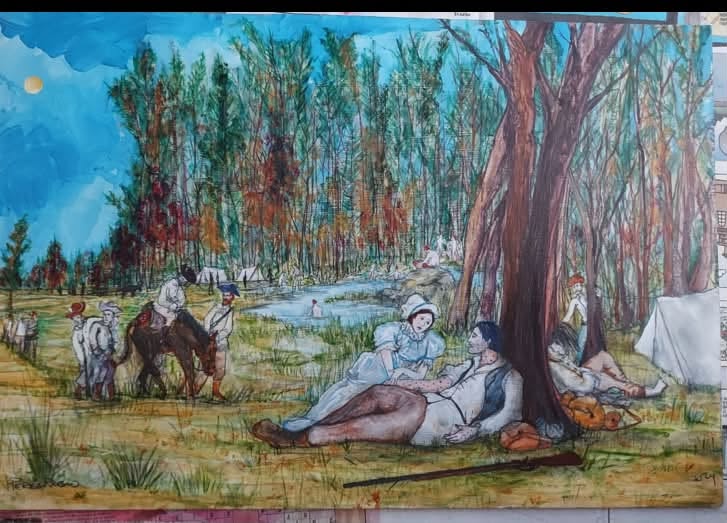
This story comes from church tradition. No record has been found to confirm it, and we present it as tradition, not history.
As the tradition tells it, opposing forces found themselves on either side of the spring, “both facing a greater enemy – an outbreak of smallpox.” A truce let the sick reach the water, and “soldiers laid down their weapons for a brief period of peace.”
The tradition gives no date, units or names. Liberty Spring Presbyterian Church, named for the spring, was founded in 1785.
Marker: 539 North Main St, Cross Hill. The spring is believed to be near the church.
Read more: Legend of Liberty Springs (Durant Ashmore)
Sources: LLL, “Liberty Springs”.
Open Questions
- Where were Capt. Ridgeway’s two blockhouses? The Reedy River (Royal Gazette) or Dirty Creek / Rabon Creek (LLL)? And was there really an attack on 1 August 1781?
- Did Ridgeway die on 3 or 5 September 1781?
- Were Kellett’s and Ridgeway’s attacked by separate Cunningham detachments on the same night?
- How did Williams’s Fort fall?
- How many men died at Hayes Station?
Visiting
Most of these sites are on private land; stay at the markers. Hayes Station and the Williams markers sit inside a hunting club, so don’t visit 1 October – 1 January.
How You Can Help
If family papers, deeds or local tradition can place any of these sites, especially Capt. Ridgeway’s blockhouses, please get in touch. Every new piece of evidence helps.
Related pages: The Little River Regiment · Honor Roll · Laurens County Rev War Timeline · Robert Long
Elsewhere: Life, Liberty, Laurens