The Battle of Musgrove Mill
19 August 1780
On the Enoree River, where Laurens, Spartanburg and Union Counties meet, South Carolina

At a Glance
- When: early morning, 19 August 1780, three days after the Patriot defeat at Camden.
- Where: Edward Musgrove’s mill and ford on the Enoree River. The Musgrove house stood on the south bank, in what is today Laurens County. The ground is now part of the Musgrove Mill State Historic Site.
- Patriots: about 200 mounted militia under a shared command: Col. James Williams and his Little River Regiment (South Carolina), Col. Elijah Clarke (Georgia) and Col. Isaac Shelby (the Overmountain men).
- Loyalists: about 500: Maj. Daniel Clary’s Loyalist militia, already camped at the mill, reinforced by Lt. Col. Alexander Innes with Provincial troops and more militia.
- Result: a Patriot victory in about an hour. Innes was wounded; Capt. Shadrach Inman was killed.
- Afterward: word of Gates’s defeat at Camden reached the Patriot commanders, and they pulled back north with their prisoners.
On This Page
- The Battle
- The Numbers
- The Laurens County Connection
- The Site Today
- Sources, Open Questions, and How You Can Help
The Battle
This battle between 200 Patriot militia and a joint force of 200 Loyalist militia and 300 British Provincial troops was a surprising Patriot victory and a major turning point during the Revolutionary War. This victory boosted the failing morale of South Carolina Patriots and dispelled the British high command’s belief that they had crushed all Patriot resistance following the major Patriot defeats at Camden on August 16, 1780 and Fishing Creek on August 18, 1780.
Setting the Stage
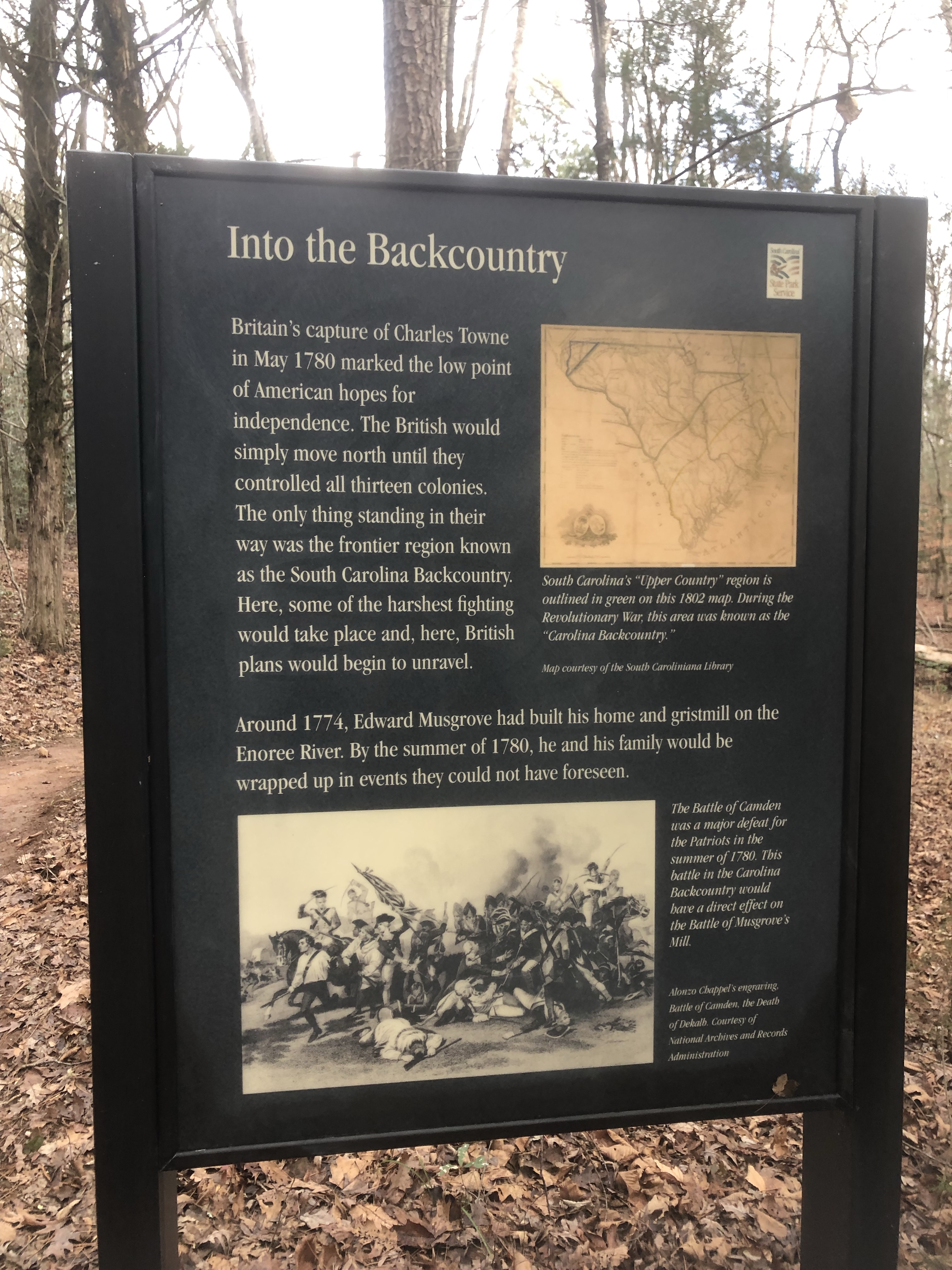
Edward Musgrove chose to stay neutral, but his mill and ford were too useful for the British to leave alone. According to the park’s “Summer Camp” sign, the British were sending their wounded to his home as early as August 8, 1780, and by August 10 a camp had been set up around it.

The visitor center’s “The Odds” panel tells what happened next. Loyalist Maj. Daniel Clary and about 200 militia had been camped at the mill since August 10. On August 18, Col. Charles McDowell sent about 200 Patriot militia, led by three colonels, on a 40-mile overnight ride from Smith’s Ford to surprise them. That same day, Lt. Col. Alexander Innes arrived with 250 to 300 more Loyalists. By morning nearly 500 were camped at the mill, and the Patriots did not know it.

The Fight
According to the American Battlefield Trust, Patriot scouts ran into a Loyalist patrol, and the surprise was lost. The Patriots threw up a breastwork on a ridge. Capt. Shadrach Inman took a small party forward, fired, and fell back as if in retreat, drawing the Loyalists after him. “When Innes’s men were within 70 yards, the Patriots open fired with devastating effect.” The Loyalists fixed bayonets and pressed Shelby’s men on the right. Then one of Shelby’s men shot Col. Innes from his horse, the Overmountain men rallied, and the Loyalist retreat became a rout. The fight lasted about an hour.
The state historic site’s account adds that Inman had about twenty men on horseback, and that the two lines fired on each other for about 15 minutes before the turning point, when Patriot riflemen wounded Innes and killed or wounded five of the seven British officers “almost at the exact same moment.”


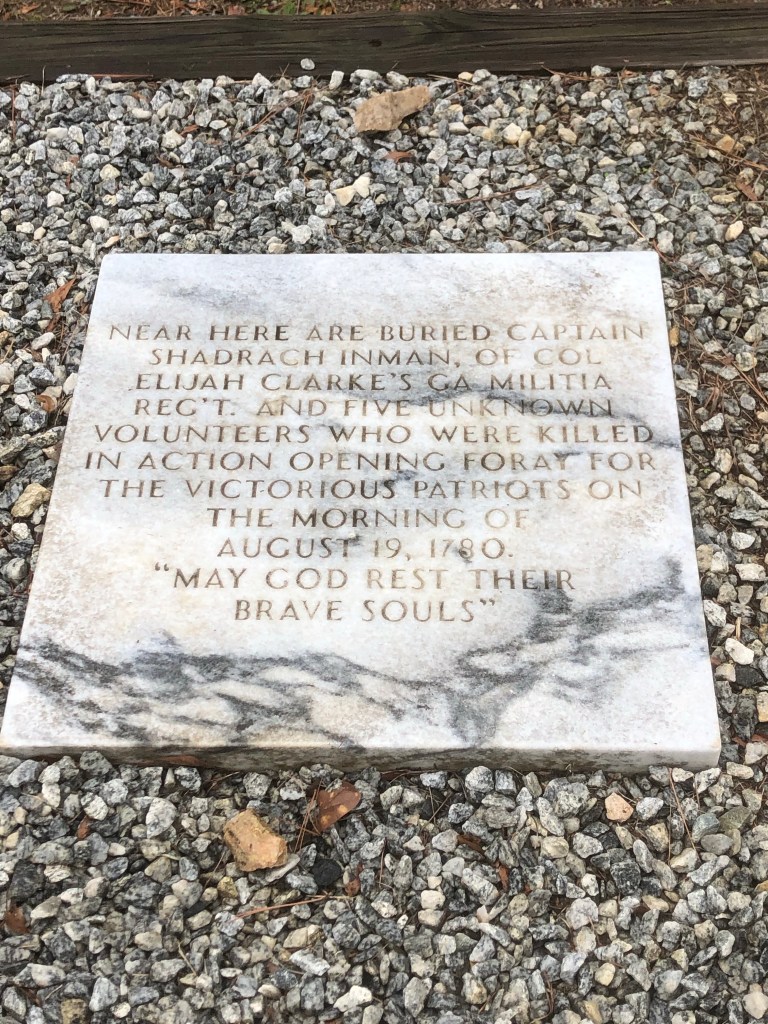
Captain Shadrach Inman
Inman, of Col. Elijah Clarke’s Georgia militia, led the party that drew the Loyalists into the Patriot fire. He was killed in the fighting. A marble marker on the battlefield reads:
“Near here are buried Captain Shadrach Inman, of Col. Elijah Clarke’s Ga. Militia Reg’t. and five unknown volunteers who were killed in action opening foray for the victorious Patriots on the morning of August 19, 1780. ‘May God rest their brave souls'”
After the Battle
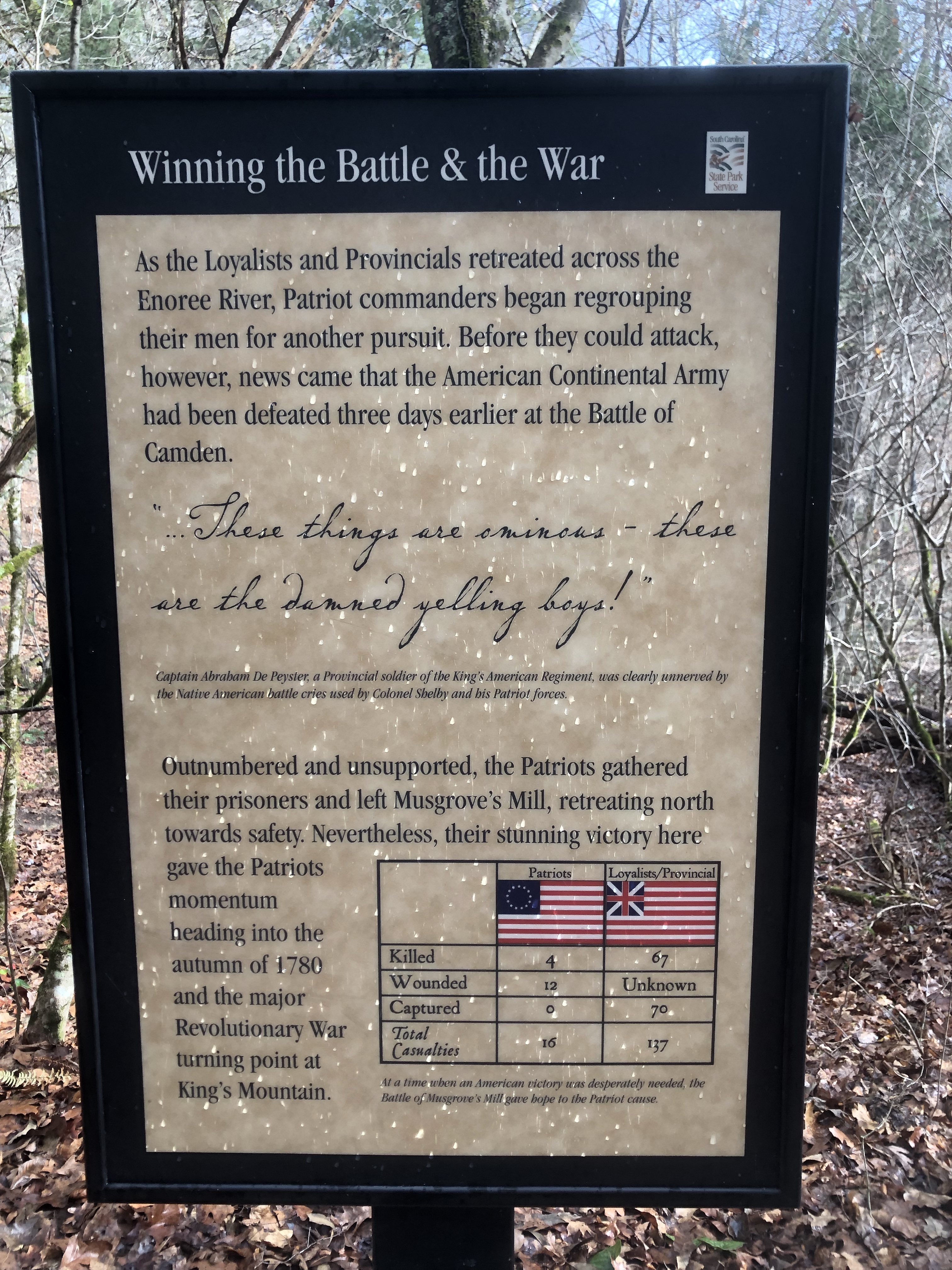
Before the Patriots could follow up, news came that the Continental army under Gen. Horatio Gates had been beaten at Camden. Outnumbered and far from help, they gathered their prisoners and withdrew north. The victory still counted: it came in the same week as the defeats at Camden and Fishing Creek, and it showed the backcountry was not beaten. Many of the same men met again at Kings Mountain in October.
The Sons of the American Revolution marker at the park entrance reads:
“On August 19, 1780 Colonel James Williams’ Little River Regiment, along with units commanded by Colonels Elijah Clark and Isaac Shelby, met British and Loyalist forces commanded by Colonel Alexander Innes at Musgrove Mill. The American Patriots were greatly outnumbered but defeated the Loyalists decisively by strategy and maneuver. Sixty British Troops and Loyalists were killed with seventy captured. This Patriot victory provided needed encouragement for the American cause following the defeat of General Horatio Gates and his Patriot command at Camden only three days previous.”
Dedicated by the Cambridge and General James Williams Chapters, South Carolina Society Sons of the American Revolution, August 17, 2013

The Numbers
The sources do not agree on how many men fought or fell. They are set side by side here rather than choosing one.
| Source | Patriots | Loyalists | Patriot losses | Loyalist losses |
|---|---|---|---|---|
| Musgrove Mill State Historic Site (banner) | about 200 | about 500 | 3 killed, 8 wounded, 0 captured | 60 killed, wounded unknown, 70 captured |
| Visitor center, “The Odds” panel | 200 militia | 300–350 militia and 150 Provincials | — | — |
| SAR marker (2013) | — | — | — | 60 killed, 70 captured |
| American Battlefield Trust | about 200 | about 500 | 16 killed and wounded | 133 killed and wounded |
| Earlier text of this page | 200 militia | 200 militia and 300 Provincials | — | — |
| Duncan (1999), in the Laurens County Rev War Timeline | 500–700 | about 500 | about 13 dead | 220 or more |
| Durant Ashmore (The Williams-Cunningham Feud) | 200 | 500 | — | — |

The Laurens County Connection
Musgrove Mill was fought on the edge of what is now Laurens County, and Little River men were in it.
- Col. James Williams of the Little River Regiment was one of the three Patriot commanders. See Wayne Lynch, “Saving South Carolina: James Williams at Musgrove’s Mill”, Journal of the American Revolution. Williams was mortally wounded at Kings Mountain two months later.
- Col. Joseph Hayes fought at Musgrove Mill, and was killed at Hayes Station in 1781.
- Samuel Hammond was there too. Robert Long testified that he guided men to Hammond’s company “just before the fight at Musgrove’s Mill, which he must have been in” (see the Robert Long page). Hammond was made a major after the battle (see Stephen Cumbo) and led the Patriots at Hammond’s Old Store.
- Mary Ramage Dillard and Capt. James Dillard lived on the Enoree, across from the Musgrove plantation. Her story is told in the visitor center at the state historic site.
- The Musgrove’s Mill Chapter of the DAR, with the Henry Laurens Chapter, placed the memorial tablet at Duncan Creek Presbyterian honoring sixteen of its Revolutionary soldiers.
Colonel James Williams

A second SAR marker at the park tells his story:
“James Williams was born in Virginia in 1740. He married Mary Wallace in 1762, and the couple had eight children. The Williams family moved south to Caswell County, N.C., then to present day Laurens County, S.C. in 1773. Williams served in the First Provincial (S.C.) Congress in 1775 and in the Second Provincial Congress convened later that year. He served on the Committee on Safety, a military group that protected S.C. backcountry from Cherokee Indian raids. A Colonel in the S.C. Militia, he led his Little River Regiment to victory at Musgrove Mill and later at Kings Mountain where he died on October 8, 1780. His sons, Daniel and Joseph (both teenagers) died at Hayes Station November 17, 1781 at the hand of Loyalists led by Bloody Bill Cunningham.”
Dedicated by the Cambridge and General James Williams Chapters, South Carolina Society Sons of the American Revolution, August 17, 2013
Editor’s note: the date of the Hayes Station massacre varies by source: this marker gives November 17, 1781, the visitor center map gives November 19, and other sources give November 18. See the Hayes Station page.

Neighbors on the 1825 Map
A wayside at the ford reproduces part of Robert Mills’ 1825 map of Laurens District. Just south of Musgrove’s Ford, near Duncan’s Creek, it marks “Adair’s” and “Holland”.

The Site Today
The mill site, the ford and the Loyalist camp ground are part of the Musgrove Mill State Historic Site, which also manages Blackstock’s Battlefield. Trails lead past the wayside signs and the Inman marker, and a short paved trail goes to Horseshoe Falls. The visitor center has a small museum.
The Mill and the Ford


The Visitor Center


Walking the Park
These photos are from my visits.


More photos, and locations for each marker, are at the Historical Marker Database.
Video
More Photos


Sources and Resources
- Musgrove Mill State Historic Site, South Carolina State Parks: banner, visitor center exhibits and wayside signs
- Musgrove Mill, American Battlefield Trust
- Sons of the American Revolution markers, “The Battle of Musgrove Mill” and “James Williams at Musgrove Mill” (2013)
- Wayne Lynch, “Saving South Carolina: James Williams at Musgrove’s Mill”, Journal of the American Revolution (2014)
- Robert Mills, Atlas of the State of South Carolina (1825), Laurens District
- Historical Marker Database, Musgrove Mill markers
- Laurens County, SC – Rev War Timeline (cites Duncan 1999)
- Robert Long, testimony for Samuel Hammond, in the Logan Manuscript (see the Robert Long page)
Open Questions
- How many men fought? Counts for the Patriots run from about 200 to 700, and Loyalist losses from 60 killed to more than 220 casualties. See The Numbers.
- Who else from the Little River Regiment was there? Williams and Hayes are known. Were others on the Honor Roll there too?
How You Can Help
Do you descend from someone who fought at Musgrove Mill, on either side? Do you have a pension application, family papers or photographs that place an ancestor there? Please get in touch.
The two SAR markers at the park were dedicated in part by the General James Williams Chapter of the South Carolina Society, Sons of the American Revolution, named for the Little River Regiment’s colonel.
Related pages: Mary Ramage Dillard · Little River Regiment Honor Roll · Robert Long · Hayes Station · Kings Mountain · Hammond’s Old Store · Laurens County Rev War Timeline · Rev War Sites of Laurens County