The Battle of Lindley’s Fort
15 July 1776
Near Rabon Creek, Ninety Six District (now Laurens County), South Carolina

At a Glance
- When: the early hours of 15 July 1776, two weeks after the Cherokee went to war against the South Carolina settlements.
- Where: Lindley’s Fort, a fortified homeplace from the Anglo-Cherokee War of the early 1760s, near Rabon Creek in what is now Laurens County. The site was nominated to the National Register of Historic Places in 1977.
- Defenders: Major Jonathan Downs and about 150 men of the Little River Regiment, with the settlers who had taken refuge there.
- Attackers: about 190: 88 Cherokee and 102 Loyalists painted as Cherokee (the “Scopholites”), led by Capt. David Fanning.
- Result: a Patriot victory. The attackers pulled back before dawn, leaving several dead. Thirteen were captured and sent to the jail at Ninety Six; Fanning escaped to North Carolina.
- Afterward: about 430 more men under Lt. Col. James Williams and Lt. Col. John Lisle, two companies of Col. Richard Richardson’s regiment and Capt. Thomas Woodward’s Rangers joined Downs. Major Andrew Williamson arrived on 17 July.
On This Page
- The Fort
- The Battle
- The People
- The Historical Markers
- At the Laurens County Museum
- Sources, Open Questions, and How You Can Help
The Fort
“Lindley’s Fort played a small but significant role in the revolutionary history of the Saluda river in the old 96 district. It was considered an old Fort in 1776. It is believed that the Fort was constructed by a private individual for needed protection in the Backcountry. It is possible that the Fort was built during the early 1760s since there were Indian disturbances in the area during that time.
The site is located on a wooded hill the highest rise of land surrounded mostly by open fields. The rise is approximately 25 to 30 feet above the adjacent land. On the top of the rise, evidence of a ditch approximately 3 feet in width is present . There are considerable stones scattered throughout, with what appears to be two rock-lined pits within the area encompassed by the ditch.”
This excerpt was taken from the National Register of Historic Places nomination form for Lindley’s Fort site, filed in 1977.

A Fort Built With Logs
The Battle
Part of the British plan of attack was to encourage Indian uprisings in the Backcountry. At this point, Lindley’s Fort became very important to the area residents.
About 190 Cherokees and Loyalists dressed as Cherokees (Scopholites) attacked the fort around midnight.
Durant Ashmore tells the story in The Battle of Ft. Lindley (Laurens County 250, 22 July 2025): after a two-hour gun battle, the defenders burst open the gates and charged out, and in the morning they found abandoned horses and a camp in disarray.

Editor’s note: the panel calls him Capt. Downs. The historical marker, Durant Ashmore and Legends of America all call him Major.
Further reading: The March of the Scopholites
The People
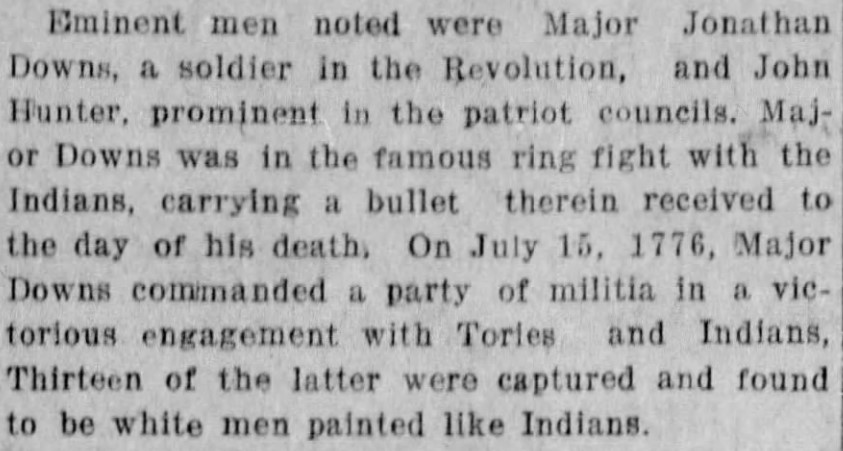
Major Jonathan Downs
Jonathan Downs later became a major in the Little River Regiment, and escaped with his life from the massacre at Hayes Station. According to the Laurens County Museum, he was wounded a month after Lindley’s Fort at the Ring Fight (see Susan Long’s story of the Ring Fight on the Robert Long page). See also Jonathan Downs on the Honor Roll.
Jonathan Downs pension application
Captain James Lindley
Captain James Lindley, owner of the Fort at the time of the Revolution, was a Loyalist. He held at least one meeting of Loyalists at his home.
Durant Ashmore writes that Lindley, a former colonial justice of the peace, led the attack on his own homeplace, which had been taken from him (The Battle of Ft. Lindley).
The Historical Markers
Lindley’s Fort
On July 15, 1776, a number of Indians and Tories attacked this frontier fort where area settlers had gathered for protection. Major Jonathan Downs, with a company of men, had arrived the previous evening & helped repulse the attack. This victory gave encouragement to the American cause locally. The site is located about 600 yds. south.

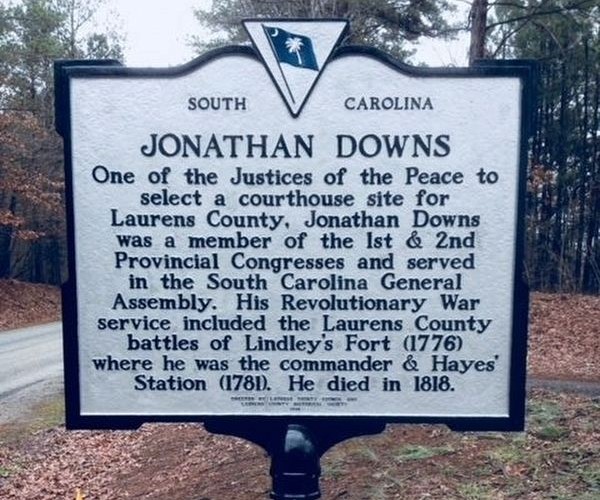
Jonathan Downs
One of the Justices of the Peace to settle a courthouse site for Laurens County, Jonathan Downs was a member of the 1st & 2nd Provincial Congresses and served in the South Carolina General Assembly. His Revolutionary War service included the Laurens County battles of Lindley’s Fort (1776), where he was commander, & Hayes’ Station (1781). He died in 1818.
At the Laurens County Museum

Sources and Resources
- National Register of Historic Places (nomination form, 1977)
- Durant Ashmore, The Battle of Ft. Lindley, Laurens County 250, 22 July 2025
- Lindley’s Fort, South Carolina, Legends of America
- Lindley’s Fort Synopsis at Carolana
- Historical Marker Database – Lindley’s Fort
- The March of the Scopholites, Southern Campaigns of the American Revolution
- Jonathan Downs, pension application W21000
- The Laurens County Museum, Laurens, S.C.
Open Questions
- Who built the fort? The National Register form says a private individual, probably in the early 1760s, during the Cherokee troubles.
How You Can Help
Do you descend from someone who was at Lindley’s Fort in July 1776, on either side? Do you have family papers, artifacts or photographs of the site? Please get in touch.
Related pages: Hayes Station · Little River Regiment Honor Roll · The Little River Regiment · Robert Long · Laurens County Rev War Timeline · Rev War Sites of Laurens County