The Hawryluk Family
Paraska Hawryluk (Polly Mary Patrick), from Galicia to Milwaukee and Chicago
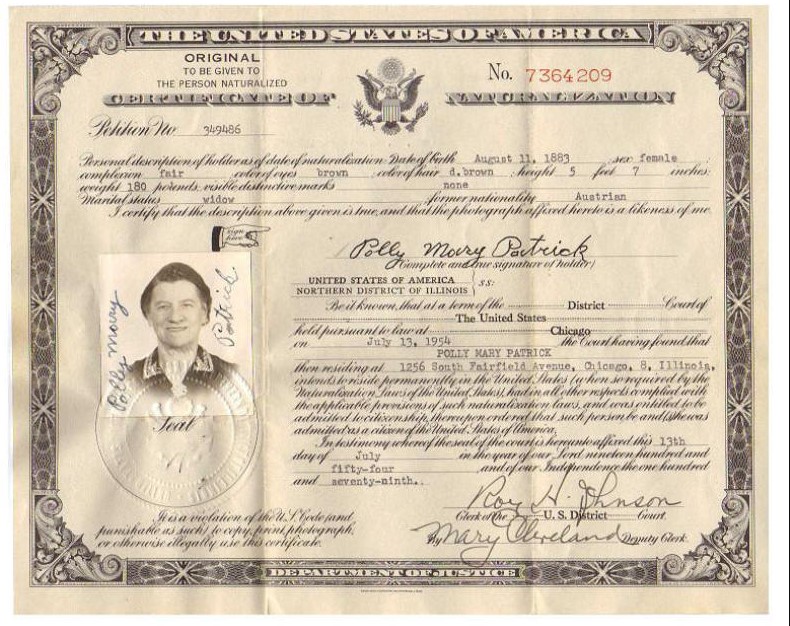
My great-grandmother Paraska Hawryluk was born in Galicia, then part of the Austro-Hungarian Empire and now divided between western Ukraine and southeastern Poland. She came to the United States in 1914. By 1920 she was married to Roman Patruck and living in Milwaukee, Wisconsin. She later moved to Chicago, and on 13 July 1954, by then a widow, she became a United States citizen. Her son Frank Patrick married Camille Leonetti; they were my grandparents (see Leonetti Family).
At a Glance
- Names: Paraska (Paruska) Hawryluk; Mary Patruck (1920 census); Paruska Patrick, changed by the court in 1954 to Polly Mary Patrick
- Born: Galicia; 11 August 1883 by her naturalization, about 1892 by the 1920 census
- Came to the United States: 1914
- Husband: Roman Patruck (later Patrick); she was widowed by 1954
- Son: Frank Patrick, who married Camille Leonetti (my grandparents)
- Homes: Ward 4, Milwaukee, Wisconsin (1920); 1256 South Fairfield Avenue, Chicago (1954), next door to the Leonettis’ 1930 home at 1258
- Naturalized: 13 July 1954, U.S. District Court, Northern District of Illinois, Petition 349486
On This Page
- Her Name
- When Was She Born?
- Naturalization and Name Change, 1954
- The 1920 Census
- The Russian Militia Certificate
- Photographs
- Olena (Elena, Helen)
- Sources
- Open Questions
- How You Can Help
Her Name
Paraska is the everyday Ukrainian form of Paraskeva, a common name among Ukrainians and Rusyns. It comes from the Greek paraskeve, “Friday” or “Day of Preparation,” and was often given to girls born on a Friday. Paruska is an affectionate form of the same name.
In America she used the name Mary, and she appears as “Mary Patruck” in the 1920 census. When she was naturalized, the court formally changed her name from Paruska Patrick to Polly Mary Patrick.
The surname Patruck is probably an English spelling of the Ukrainian surname Petruk or Patruk (Петрук), which the family later Americanized to Patrick.
When Was She Born?
The records disagree.
| Record | What it says | Birth year |
|---|---|---|
| 1920 U.S. census, Milwaukee | Age 28 | about 1891–1892 |
| 1954 certificate of naturalization | Born 11 August 1883 | 1883 |
She swore to her birth date for naturalization, while a census age could have been given by anyone in the household. Her naturalization petition and declaration of intention should show which is more likely.
Naturalization and Name Change, 1954

The 1920 Census
Mary is indexed in the 1920 census as Mary Patruck.
| Item | As recorded |
|---|---|
| Home | Ward 4, Milwaukee, Milwaukee County, Wisconsin |
| Age | 28 (born about 1892) |
| Birthplace | Galicia |
| Father’s and mother’s birthplace | Galicia |
| Relation to head of house | Wife |
| Spouse’s name | Roman |
| Marital status | Married |
| Year of immigration | 1914 |
| Able to read and write | Yes |
The Russian Militia Certificate
Among the family papers is a printed Russian Empire militia certificate. The Empire issued these to men enrolled in its reserve militia. The back reads, in translation:

Extract from the Statute on Military Service
1) Each year, after men are taken into the regular army, the District Military Service Board enrolls in the militia, by the lottery list, everyone else called up, except those plainly unfit to bear arms. Men stay enrolled until age 40.
2) The militia is called up only in extraordinary wartime circumstances.
3) It is disbanded at the end of the war, or earlier if no longer needed.
4) Each enrolled militiaman is given a permanent certificate showing his lottery number. It proves he appeared for military service.
5) He must show this certificate when he marries and when he enters state or public service.
Ministry of Internal Affairs circulars of 1884: A militiaman called to active duty who brings his own usable boots and underclothes will be paid for them: 5 rubles for boots, 50 kopecks per shirt, 35 kopecks per pair of drawers, and 4 rubles for a sheepskin half-coat.
Only men received these certificates, and only subjects of the Russian Empire. Galicia belonged to Austria, so the card is unlikely to be Paraska’s own. It probably belonged to her husband Roman, who would have needed it to marry. If so, Roman may have come from Russian-ruled Ukraine, such as Volhynia or Podolia, rather than from Galicia. The name on the front of the card should settle it.
Photographs
A Portrait from Śniatyn


Probably Paraska (Mary Patrick), Śniatyn, about 1900–1911. Studio of Ignacy Schmitzler. Family photograph.
This studio portrait shows a young woman in the traditional dress of Pokuttia, the region around Śniatyn in southeastern Galicia. She wears an embroidered blouse, a sleeveless vest, a striped wrap skirt, strings of beads and boots. It is probably Paraska, though it may be her sister.
The back is printed in Polish: “Photographic studio of Ignacy Schmitzler in Śniatyn, beside Baron Hirsch’s school. Enlargements made of any photograph, up to life size, with artistic finish and likeness guaranteed. Negatives are kept.” Across the top, someone later wrote “Mary Patrick” in pencil. That was her American name, so the note was added in the United States.
Śniatyn (Ukrainian Sniatyn) is a market town on the Prut River, now in Ivano-Frankivsk Oblast, Ukraine. A studio portrait was usually taken in the nearest town, so Paraska’s family may have lived in Śniatyn or one of the villages around it.
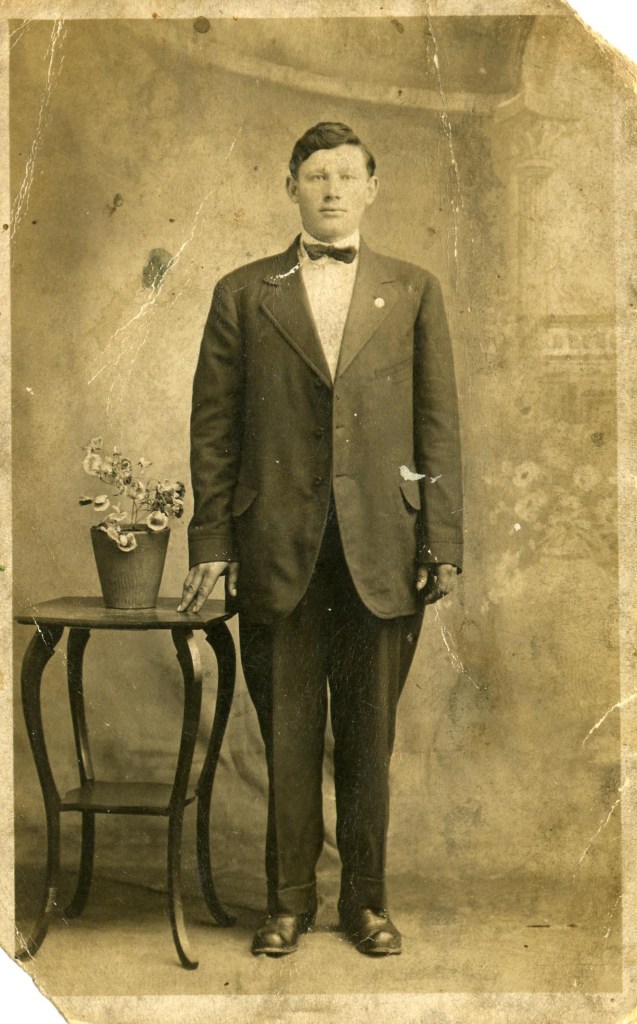
Roman Patrick

Two portraits, probably from the 1910s or 1920s: a young man seated in a wicker chair and holding a rolled document, and a woman with a small child. Neither has been identified.
Olena (Elena, Helen)
This photograph of Olena is in the family collection. Her name is also given as Elena or Helen, the Russian and English forms of the Ukrainian Olena. She was born about 1903. Almost nothing else is known about her: not her surname, or how she was related to Paraska.
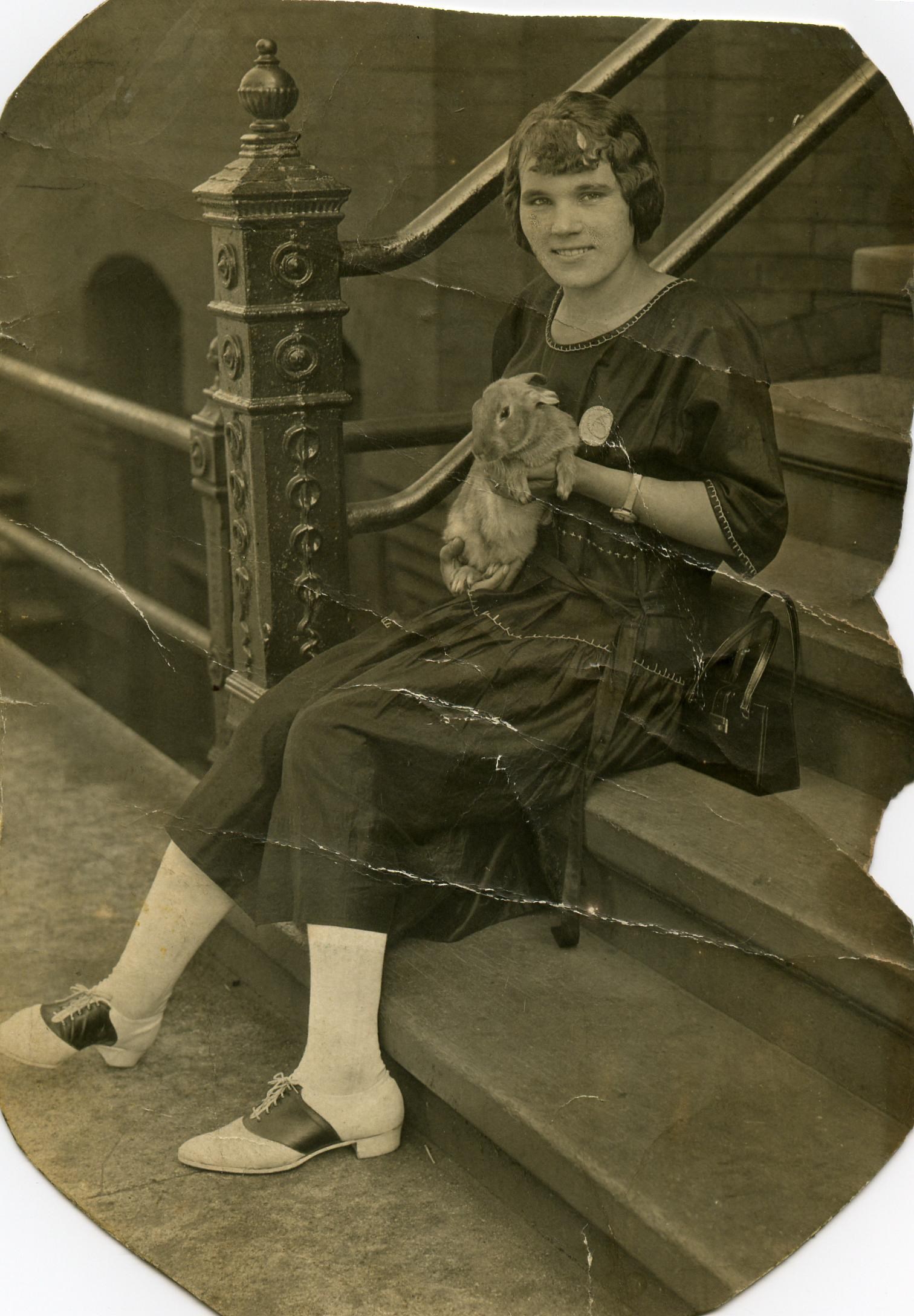
She sits on the stone steps of a large building, beside an ornate iron newel post, holding a pet rabbit. Her bobbed hair, dropped-waist dress and saddle oxfords suggest the early 1920s, when she was about twenty. She wears a round pin or badge on her dress, which may be from a club, school, church or event.
Do you know her? If you recognize Olena, the pin she is wearing, or the building and its iron railing, please send a note. Any of these could tell us who she was and where the photograph was taken.
More Photos

Sources
- Certificate of naturalization and name change, Petition 349486, U.S. District Court, Northern District of Illinois, 13 July 1954; family papers.
- United States Federal Census, 1920, Ward 4, Milwaukee, Wisconsin.
- Russian Empire militia certificate, family papers; translated for this page.
- Studio portrait, Ignacy Schmitzler, Śniatyn, about 1900–1911; family photographs. Studio card on the back translated from Polish for this page.
- Family photographs.
Open Questions
- Did Paraska come from Śniatyn or a village nearby? Who were her parents?
- Was she born in 1883 or about 1892? Her naturalization petition and declaration of intention may tell.
- Does any record show the surname as Petruk or Patruk?
- Whose name is on the front of the militia certificate? Where was Roman born, and when did he die?
- When and where did Paraska and Roman marry?
- When and where was Roman’s studio portrait taken?
- Is the Śniatyn portrait Paraska or her sister? Did Paraska have sisters, and did any of them come to America?
- Who is in the unidentified photographs?
- Who was Olena (Elena, Helen)? What was her surname, how was she related to Paraska, and where was her photograph taken?
How You Can Help
If you know anything about the Hawryluk or Patrick (Petruk) families, or can identify the photographs or Olena, I would love to hear from you.


Paternal Lines: Family History · Leonetti Family · Hawryluk Family