Adair Coat of Arms and Crest
The Adair coat of arms and the origins of the name
The arms of Adair of Kinhilt, Wigtownshire, Scotland, and Ballymena, County Antrim, Ireland: red hands, a bloody head and two mottoes. This page gathers a blazon brought back from Scotland, a 1963 heraldic analysis, an artist’s critique of it, and what the name dictionaries say about the Adair name.
At a Glance
- Arms: per bend, or and argent, three dexter hands gules couped and erect
- Crest: a man’s head affronté, couped at the neck and distilling blood
- Mottoes: “Loyal au Mort” (Loyal to Death); “Moribus Victoria Dextris”
- Family seats: Kinhilt, Wigtownshire, Scotland; Ballymena, County Antrim, Ireland
- Name origin: Scottish Edzear (Edgar), or Gaelic ath + dare, “ford of the oaks”
On This Page
- The Blazon
- The Arms, Crest and Mottoes
- Patsy Lowrey Domengeaux’s Analysis, 1963
- Eddie Geoghegan’s Notes
- More Renderings and Photographs
- The Adair Name
- Famous Adairs
- Sources
- Open Questions
- How You Can Help
The Blazon
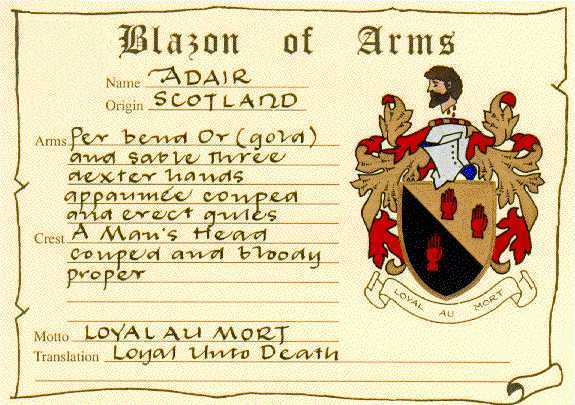
Fellow researcher Steven Addair shared this certificate. His sister, Colette Addair Tarver, visited Scotland and brought the blazon back. Many thanks to Steven for sharing it.
Steven is researching this line: his father Henry Addair; grandfather Thomas Addair; great-grandfather Henry Addair; 2nd great-grandfather Moses Addair (born 1830 or 1834); 3rd great-grandfather John Adair; and 4th great-grandfather James Adair (born 1752?). The second D in Addair seems to have been added during Moses Addair’s early life, for no known reason. Researchers who would like to reach Steven can write to me through the form below.
The Arms, Crest and Mottoes

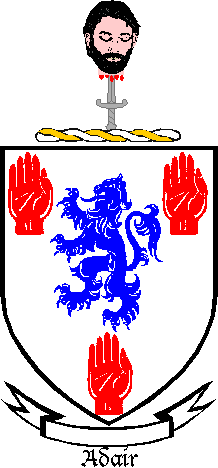
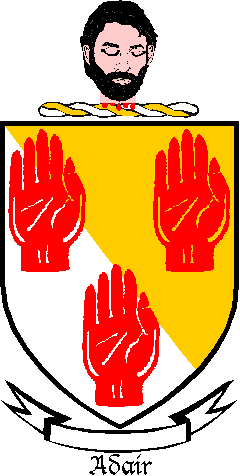
- Arms: Per bend, or and argent, three dexter hands gules couped and erect.
- Crest: A man’s head affrontée, couped at the neck and distilling blood.
- Motto above: “Loyal au Mort” (Loyal to Death).
- Motto below: “Moribus Victoria Dextris.” Precise meaning: “Manners victorious against the right hand.” Loosely: manners win over the strong hand, as in diplomacy is superior to force.
Patsy Lowrey Domengeaux’s Analysis, 1963
Authority Woulfe gives the Irish O’Daire as the descendants of Daire (same as the Latin “Darius,” meaning King), while Black’s Surnames of Scotland states that Adair and Edzear were the same, both forms being found on the same page as late as 1625. Mr. Black feels certain that these are a form of Edzear. He also does not believe the tradition that Fitzgerald of Adare, fugitive son of Fitzgerald, Earl of Desmond, Adare of Ireland, founded the family in Kinhilt, Scotland, around 1388. There is earlier evidence of Adairs in Scotland.
The arms depicted above are the arms of Adair of Kinhilt, County Wigton, Scotland and Ballymena, County Antrim, Ireland, according to Authority Papworth. This Adair of Kinhilt uses the arms exactly as above, except that it does not include the lower motto “Moribus Victoria Dextris.” We can assume that this motto was added later, perhaps by the American branch of this family.
The red hand was found all over the world, even amongst Native Americans, and on the walls of the caves of the prehistoric Cro-Magnons. It symbolizes strength, force, and health. In these arms it probably does have an influence from Irish sources, perhaps more from the traditional story of the Irish chieftain who cut off his hand while racing through the surf, and threw it ashore to claim the first grasp and thus the first choice of the new land of Ireland that they were just approaching. The same source was the origin of the famous Red Hand of Ulster used by baronets who settled there in later times as homesteaders. Adair was there prior to the Red Hand of Ulster users.
The crest of a bearded and bloody head probably commemorates some ancient hand-to-hand encounter, or perhaps the capture and execution of an enemy chieftain. It may also symbolize some ancestral exploit in the Crusades (reference the explanation of colors). The Irish generally cut off the heads of chiefs they had slain in battle, as they considered no man actually fully dead until his head was removed.
Key to the Colors:
Argent with or (silver and gold) symbolizes the will to avenge Christ’s blood.
Argent with gules (silver and red) symbolizes honest boldness.
Or with gules (gold and red) symbolizes a disposition to shed one’s blood in order to acquire riches.
Family records report that these arms were quartered with Shafto – that is, the Adair arms and the Shafto family arms both be shown on one shield, the shield being divided into equal quarters. The records do not show in which two quarters the Shafto and Adair arms go, nor whether there may be one or two others also quartered – as we are left with two empty quarters with this description. Strictly speaking, a quartered shield tells who a man’s mother was, and is shown because she is an heiress, and the last of the family line.
A present-day Adair using the arms with the Shafto devices would be declaring that his mother was a Shafto, which does not apply, and is not authentic for future generations. Arms were sometimes shown quartered in this manner on a slate tombstone, but even this was unusual.
Author Ellis of “Who Are You?” gives us “Argent a lion rampant azure between three hands gules” as the arms of the Scotch-Irish Adairs of Maryland, New Jersey, Pennsylvania, Kentucky, and South Carolina…with crest a bearded head on the point of a dagger dripping blood. Here we see a very similar coat-of-arms, with the exception of the shield being all silver, and in the center a blue lion between the familiar three red hands.
The blue lion is of great interest to Genealogist Joseph Ferrier, as it is almost always a Welsh symbol. There are many heraldic lions, but few blue ones. Historically, the Welsh heralds established these arms, already in use, in a systematic way sometime around 1200 AD, at the time of the early Tudors.
The Welsh-type coat-of-arms may have been the forerunner of the one described in present records of the Adair family. The Scotch-Irish Adairs may have dropped the blue lion because it was indeed so definitely a Welsh symbol.
Patsy Lowrey Domengeaux, Heraldic Artist, Houston, Texas, 16 October 1963
Eddie Geoghegan’s Notes
Eddie Geoghegan, the artist and researcher who drew the renderings above, disputes some of the observations in the 1963 analysis:
1. “Authority Woulfe gives the Irish O’Daire as the descendants of Daire”
In fact, O’Daire is an Irish name in its own right and while often Anglicized as Adair, is not related to the much more numerous Adair name of Scottish origin.
2. “The red hand was found all over the world…”
In heraldic terms, the severed red hand is almost exclusively Irish.
3. “The Blue Lion…is almost always a Welsh symbol”
That is simply not true, there are many, many examples of the “lion rampant azure” among Irish coats-of-arms.
Eddie Geoghegan
More Renderings and Photographs

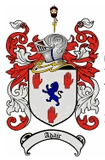
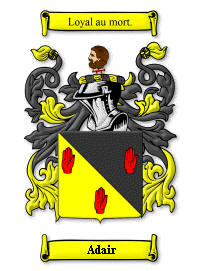

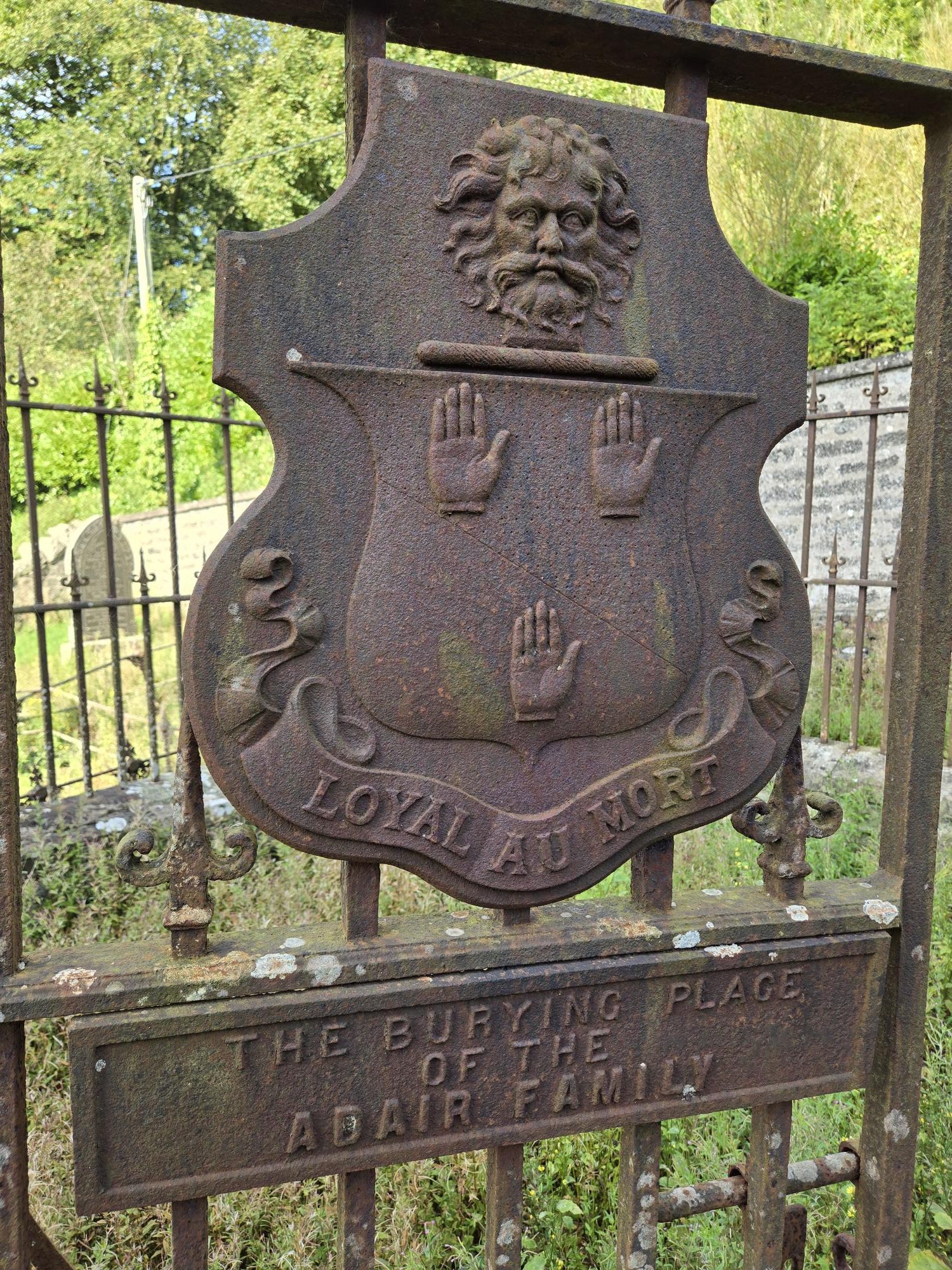
Photo courtesy of Joseph Park.
The Adair Name
ADAIR
S.S. Count: 25,142
Origin: English: derived from the Old English first name Eadgar, which is derived from words meaning prosperity and spear.
Irish, Scottish: 1) Derived from the Gaelic words “ath” and “dare”, meaning a shallow place in a river and oaks. The name was given to those who lived near such places. 2) trans-formation of the Scottish first name Edzear, which is the equivalent to the English first name Edgar.
Source: The Encyclopedia of American Family Names by H. Amanda Robb & Andrew Chesler, 1995
The same entry lists three famous Adairs:
Famous Adairs: JAMES ADAIR (1709?-1783), apparently born in Ireland but an emigrant to South Carolina, was a pioneer trader with American Indians and the author of The History of American Indians.
JOHN ADAIR (1757-1840) of South Carolina was a soldier during the American Revolution, after which he migrated to Kentucky. There, he was elected to the state legislature a number of times, served as governor, and then represented Kentucky in the United States House of Representatives.
WILLIAM P. ADAIR (1828?-1880) was assistant chief of the Cherokee nation. During the Civil War, he lead a band of Native Americans in the Confederate Army and fought at the Battle of Pea Ridge. He later represented his tribe in government relations in Washington, D.C.
Genealogies: The Descendants of James Adair was compiled by Miriam Dabbs Adair and published in Clarksdale, Mississippi, in 1976.
Famous Adairs
From Who’s Who in American History. James Adair the Indian trader has his own page; John Adair of Kentucky’s longer biography is on the Adair family scrapbook.
ADAIR, JAMES: Indian trader; author. b. County Antrim, Ireland, circa 1709. Came to America 1735; traded with the Catawba and Cherokee Indians 1735-44, with Choctaw Indians 1744-51; moved to District 96, Laurens County SC 1751; commanded band of Chickasaws as Captain during Indian War 1760-61. Author: The History of the American Indians (maintaining Indians are descendants of ancient Jews), 1775. Died NC circ 1783.
ADAIR, JOHN: senator, Gov. KY; b. Chester County, SC Jan 9, 1757; s. Baron William Adair. Settled in Mercer County, KY, 1786; commanded KY militia, 1792, later Brig.. general; member KY House of Representatives from Mercer County, 1793-95, 1798, 1800-03; speaker 1801-03; member US Senate from KY 1805-06, resigned 1806; aide to Governor Shelby during War of 1812; fought at battles of Thames and New Orleans; Gov. KY 1820-24; member US House of Representatives from KY 22d Congress, 1831-33; Adair County, KY named in his honor. Died Harrisburg, KY May 19, 1840, buried Frankfort, KY
Who’s Who in American History, The Historical Volume (1607-1896)
More Photos

Sources
- Blazon certificate shared by Steven Addair.
- Patsy Lowrey Domengeaux, heraldic analysis of the Adair arms, Houston, Texas, 1963.
- Notes and renderings by Eddie Geoghegan.
- H. Amanda Robb and Andrew Chesler, The Encyclopedia of American Family Names (1995).
- Who’s Who in American History, The Historical Volume (1607–1896).
- Photograph of Adair Cemetery, County Antrim, courtesy of Joseph Park.
Open Questions
- Which Adair family used the quartering with Shafto, and when?
- When was the lower motto, “Moribus Victoria Dextris,” added?
- What is the 1968 Royal Masonic Institution for Boys piece, and whose was it?
How You Can Help
If you have Adair heraldry, a family seal or a blazon of your own, or would like to reach Steven Addair, please write to me.


From the blog: Adair Heraldry: a gilt livery button with the Adair crest
Adair Family: Family History · Joseph Adair, Sr. · Sourced Timeline · Adair Family Scrapbook · James Adair · Marj’s James Adair Research · Adair Coat of Arms