The Hayes Station Massacre
also known as the Battle of Edgehill Plantation, or “Edgehill’s old field”
19 November 1781
(one contemporary account gives 18 November; see Open Questions below)
Eastern Laurens County, South Carolina

Click here to donate to the upkeep and preservation of this sacred place.
The South Carolina Battleground Preservation Trust (SCBPT) is a 501(c)(3) not-for-profit corporation, established in 1993, that preserves South Carolina’s historic battlegrounds and military sites.

On This Page
- At a Glance
- What Happened
- The Capitulation: Judge Burke’s Letter, 1784
- The Fallen
- Captives and Survivors
- Aftermath
- The Monuments
- In Their Own Words
- Visits and Photographs
- Sources, Open Questions, and How You Can Help
At a Glance
- Where: a fortified house on the plantation of Loyalist Col. Thomas Edghill, near Little River in what is now eastern Laurens County. Col. Joseph Hayes had taken it over as a Patriot station.
- Who: Col. Joseph Hayes and the men of the Little River Regiment (“an American party of 35 men,” according to Judge Burke), against Maj. William “Bloody Bill” Cunningham and his raiders (“about 150 white men & negroes,” Burke; other writers give 200 to 300 for Cunningham’s whole expedition).
- What: after a firefight of about three hours, the Loyalists set the house on fire. Hayes surrendered under written terms, a “Capitulation … formally signed & interchanged.” Cunningham broke the terms. Hayes and Capt. Daniel Williams were hanged and cut down, and the prisoners were slaughtered.
- The dead: fourteen names on the monument and in Ramsay’s history (1785). Judge Burke (1784) wrote that “nineteen of them were butchered.” Capt. Laughlin Leonard, who is not on the monument, was also killed.
- Part of: Cunningham’s “Bloody Scout” of November 1781, which came two days after the killings at Cloud’s Creek.
What Happened
In November 1781, Maj. William Cunningham rode out of the Ridge country, under orders from the British commander in Charleston, Col. Nisbet Balfour. By Judge Burke’s account he killed “every person he met with, (it is said to the number of 50) whom he suspected to be friends to this Country, & burnt their Habitations.” On 17 November his party massacred the Patriots at Cloud’s Creek. Two days later they reached Hayes Station.
The station was a two-story log house on the plantation of Col. Thomas Edghill, a prominent Loyalist whom the Patriots had driven off his land. Col. Joseph Hayes, who had commanded the Little River Regiment since James Williams’s death at Kings Mountain, had fortified it as a post. Neighbors later watched the events from a nearby rise known as Edghill’s Mountain, afterwards Hayes’ Mountain (Lipscomb, 1979).
Someone warned the men at the station that Cunningham was near, but the accounts disagree on who it was. Wood names William Caldwell, a neighbor whose brother’s house was burning. Dr. Frank Wyman (2004) says “the rider” saw smoke from the Williams house and barns. The traditional account below names Capt. John Owens.
The Patriots refused to “surrender at discretion.” A hot fire was kept up “for about three hours,” with losses on both sides. The raiders took the outbuildings and then set the house alight. Later accounts say they threw irons heated at the nearby forge onto the roof. Two Patriots fell in the fighting. One of them was probably Capt. Laughlin Leonard, who died inside the house (Wood; Mangum). One of Cunningham’s men was killed outside.
With the house burning, Hayes accepted terms: his men would march out, lay down their arms, and be held as prisoners of war. Cunningham broke the agreement at once. Hayes and Capt. Daniel Williams, his second in command, were hanged. Most accounts say they were hanged from a fodder-stack pole that broke under them. Judge Burke says it was “the limb of a tree.” Cunningham then cut them down with his sword. When Daniel’s young brother Joseph cried out, Cunningham killed him too. Cunningham “with his Own hands slew some of the prisoners & desired his men to follow his example.”
Some of the killing was personal. Cunningham believed Daniel Williams had killed his friend Thomas Ellison a few days before. He killed John Cook himself, because Cook had helped kill Cunningham’s brother and maim his father in 1778 (Wood).

The Traditional Account
The account below is widely repeated, from Hayes’ Station – The American Revolution (Carolana.com). Unverified: no period document we have found mentions the tavern, the stage-coach stop, or Capt. John Owens. If you know of one, please let us know.
“Joseph Hayes owned a tavern adjacent to Edgehill Station – a stop along the local stage coach line. He and about two dozen of his men were sitting down to a nice meal when a colleague, Capt. John Owens, rode up and informed the men that smoke was coming out of the nearby plantation house of the late Brig. Gen. James Williams’ widow.
Hayes and his men jumped up from their meal and followed Capt. Owens out of the tavern and up a small hill to gather at an old Cherokee War Block House – to see what was going on at the neighbor’s home. They were instantly surrounded by “Bloody Bill” Cunningham with about 300 Loyalists. Hayes and his men ran into the small block house, but it was soon torched, so they threw down their arms and surrendered.
Each man was forced to back out of the small block house to have their hands tied behind them then affixed to a long rope, ostensibly to be marched to another location. However, as soon as the last man was attached to the long rope, Cunningham started hanging them, and then his men dismembered fourteen of them. Cunningham then rode off, leaving the body parts scattered.”
The Capitulation: Judge Burke’s Letter, 1784
The earliest detailed account of Hayes Station is a letter from Judge Aedanus Burke to Governor Benjamin Guerard, dated 14 December 1784. It was written a year before Ramsay’s history appeared. Burke got his information from survivors, and he is our only source for the written surrender terms. He wrote because of what had just happened at Ninety Six: Matthew Love, one of Cunningham’s men, had been lynched by the families of the men he helped kill (see Aftermath).
“In this distressful Situation they refused to surrender at discretion; reasonable terms were offered; that they should march out, lay down their arms & be treated as prisoners of war until exchanged; & a Capitulation was formally signed & interchanged. The Americans had no sooner marched out & laid down their Arms, but the British seized Colo. Hays, & with the Capitulation in his hand, pleading the terms of it & begging for Mercy, they hanged him to the limb of a tree & then fired a Bullet thro’ him. Captn. Williams the second in Command, was treated in the same manner.”
— Aedanus Burke to Gov. Benjamin Guerard, 14 December 1784
Read Judge Burke’s full letter
Charleston 14th Decr. 1784.
Sir,
I arrived from my Circuit this Evening & take the earliest Opportunity to communicate to your Excelly. a very extraordinary affair which happened in the Town of Ninety Six on the 7th Instant. I suppose your Excelly. has heard of an Excursion made by the noted Will Cuningham in the Winter of 1781 into the interior Settlements, at the head of about 150 white men & negroes, under Orders From the British Colo. Balfour. Cuningham having killed in his rout every person he met with, (it is said to the number of 50) whom he suspected to be friends to this Country, & burnt their Habitations, came at length to a House in which were an American party of 35 men, commanded by Colo. Hayes. These refusing to surrender at discretion, an attack commenced & a hot fire kept up, with some Loss on both Sides, for about three hours; the British party possessed themselves of the out buildings, & at last set fire to the house in which Colo. Hays was posted. In this distressful Situation they refused to surrender at discretion; reasonable terms were offered; that they should march out, lay down their arms & be treated as prisoners of war until exchanged; & a Capitulation was formally signed & interchanged. The Americans had no sooner marched out & laid down their Arms, but the British seized Colo. Hays, & with the Capitulation in his hand, pleading the terms of it & begging for Mercy, they hanged him to the limb of a tree & then fired a Bullet thro’ him. Captn. Williams the second in Command, was treated in the same manner. After which Cuningham, with his Own hands slew some of the prisoners & desired his men to follow his example. A most cruel slaughter of the prisoners ensued; nineteen of them were butchered & the rest escaped their fate by means too tedious now to mention.
A man by the name of Love, who had dwelt in the district before & since the war & had married there, was one of Cuningham’s party, & a principal actor in this tragical business. Love traversed over the ground where lay the dead & the dying, his former neighbours & old Acquaintances, & as he saw Signs of Life in any of them, he ran his sword thro’ & dispatched him. Those already dead he stabbed again: & when others seemingly without Life, pierced by the point of his Sword were involuntarily convulsed with the pain, to these he gave new wounds; lest any in so dreadful a Calamity might sham death to avoid it. Many other Circumstances of barbarous insult to the dead bodies of Colo. Hays, Captn. Williams & others are related by Major Downs, Major Mulvee, Captn. Saxon & sundry other gentlemen of great worth & honor, who were witnesses of this Massacre, but fortunately escaped it; some thro’ the good will of a Neighbour, & others by the intercession of their own slaves.
Love was thenceforth held in universal execration, yet he some time ago ventured to return into the vicinity of Ninety Six. He was taken up, & a Justice of the peace committed him to Goal, thinking that such barbarity did not come under the treaty of peace, so as to shelter him from prosecution. The State’s Attorney laid the Affair before the Court of Sessions, who over ruled the prosecution; I being of opinion That under the Treaty, his Conscience & his feelings alone stood responsible for what was alledged; & on motion of his Council he was discharged. I then observed that there was no appearance, no look of disapprobation directed against a man so generally detested: all seemed to be reconciled. The determination on Love’s Affair closed the business of the Sessions, & the Court immediately adjourned to the 26th of April next.
A party of men as respectable for Services & good Character as any in the district, composed of the fathers, Sons, & brothers and friends of the slain prisoners, had attended Court, & waited until the Judge had left the Court House, & arrived at his Lodgings. And then without tumult or noise made Love a prisoner & put him on horseback: they proceeded on, & tho’ the house where they supposed the Judge had entered, led directly to the place where they intended to convey him, yet they took a Circuit another way to the skirts of a wood, where they arrived under the limb of a tree, to which they tyed one end of a rope, with the other round his neck, & bid him prepare to die; he urging in vain the injustice of killing a man without tryal, & they reminding him, that he should have thought of that, when he was slaughtering their kinsmen. The Horse drawn From under him left him suspended til he expired.
Thus I have related this unhappy Affair as I have heard it, & I can assure your Excelly., that whatever appearance this transaction may have to the contrary, the people of Ninety Six wish ardently to forget the injuries Of the War, provided those do not return among them, that have committed wanton acts of barbarity. Many plunderers and other mischievous people now set down among them without molestation; nor can I learn that there exists resentment against any man who acted like a Soldier & fought them in fair open action. But it is to be lamented that such men as Love is described to have been, will be so infatuated as to return among the Citizens, & thus prevent the restoration of the publick tranquility.
I have the honor to be Your Excellency’s Most obedt. humble Servt.
His Excellency Governor Guerard (Signed) AEdanus Burke
Source: Records of the General Assembly, Governor’s Messages, No. 313, South Carolina Department of Archives and History. The manuscript is a clerk’s copy made before 24 January 1785, when Governor Guerard laid the letter before the General Assembly. Printed in Michael E. Stevens, “The Hanging of Matthew Love,” South Carolina Historical Magazine 88, no. 1 (January 1987), and transcribed literally.
The Fallen
Ramsay (1785) wrote that “only two fell in the action, but fourteen were deliberately cut to pieces after their surrender.” His fourteen are the names on the 1910 monument. Judge Burke, writing the year before, counted nineteen. Carolana gives seventeen or eighteen. The names below are the monument’s fourteen, followed by Capt. Laughlin Leonard, who is not on the monument but was killed there. “AA” means a South Carolina Audited Account, a pay or loss claim filed after the war.
| Name | Rank | Notes | Record |
|---|---|---|---|
| Joseph Hayes | Colonel | Captain from May 1780. Colonel of the Little River Regiment from 6 Sept 1780. Pickens certified his duty “until the 19th Day of November 1781 Inclusive.” His loss inventory lists swords, pistols, a rifle, and a velvet coat and breeches. His widow was Alice (“Elly”) Hayes. | AA 3461 (SC21) |
| Daniel Williams | Captain | Eldest son of Col. James Williams, who was killed at Kings Mountain. Second in command. Rose from private to lieutenant to captain. Unmarried. His age is given as 16, 17, or 18. | AA 8541 |
| Christopher Hardy | Lieutenant | Served as a lieutenant “since the reduction of Charlestown.” His claim includes £250 in property lost in 1781. | SC3590 |
| John Neel (Neil) | Lieutenant | Listed as a sergeant on one regimental roster, and as a lieutenant under Capt. William Millwee on another. No claim found. | — |
| Clement Hancock | Lieutenant | Taken prisoner around June 1780 and held until July 1781. Returned to duty on 1 August 1781. Killed “when the said Col. Hayes was also taken & put to death.” Left a widow, Isabella, and orphans. | SC3554 |
| Joseph Williams | Private | Younger brother of Daniel, age 13 or 14. Named for Col. Hayes, his father’s closest friend. | AA 8541 |
| Joseph Irby, Sr. | Private | His widow, Frances, filed the claim. | SC4192 |
| Joseph Irby, Jr. | Private | “Under age when he was killed.” | SC4191 |
| Greaf (Grief) Irby | Private | Spelled “Great” in Landrum, “Grief” in his claim. | SC4190 |
| John Milven | Private | Known only from the roster and the monument. | — |
| James Feris (Ferris) | Private | Known only from the roster and the monument. Ramsay spells the name “Ferris.” | — |
| John Cook | Private | Served as a horseman under Capt. Benjamin Kilgore, 1779–80. Killed by Cunningham himself as revenge for 1778 (Wood). | — |
| Benjamin Goodman | Private | Lost a saddle, gun, and blanket at Hayes Station. The claim notes he “was killed in the action at Hayes’ Station.” His widow was Mary. One family compilation calls him a brother-in-law of Col. James Williams (unverified). | SC3208 |
| Yancy Saxon | Sergeant | No claim found. | — |
| Laughlin Leonard | Captain | Not on the monument. John Mangum, who served in his company, swore that he was at Edgehill’s old field “where and when Colonel Hayes and Captain Leonard were killed.” Wood says Leonard died inside the house during the fighting, which would make him one of Ramsay’s two who “fell in the action.” Tradition says his widow came the next morning to gather what she believed were his remains. | S16939 (Mangum) |
Capt. Daniel Williams and his brother Joseph were the sons of Col. James Williams, who died at Kings Mountain. Their mother, Mary Williams, lost her husband and two sons within thirteen months. Their surviving brother John swore to the family’s loss claim before Col. Levi Casey, JP, in May 1783: the articles belonged to “his two Brothers that was murdered when Col. Hays Station was taken by Wm Cunningham & his party.” Family tradition holds that Daniel threw his father’s pistols into the burning house rather than let them fall to the enemy.

How the brothers died survives only in memories handed down. Thomas Young, who was not there, had heard that Daniel threw his father’s pistols into the burning crib “rather than deliver them to the enemy.” Mary’s grandson, Col. John D. Williams, telling the historian J. H. Logan about 1858, said Joseph’s last words were a question: “Brother, what shall I tell mother when I go home?” Neither story comes from a survivor. Both are what the family and its neighbors remembered. (Young, “Memoir,” Orion, 1843; Williams to Logan, in Historical Collections of the Joseph Habersham Chapter, DAR, Vol. III, 1910, p. 110.) Read more about Joseph Williams on the Honor Roll.
Captives and Survivors
Judge Burke wrote that the survivors “fortunately escaped it; some thro’ the good will of a Neighbour, & others by the intercession of their own slaves.” William Millwee remembered that “one half the captives were killed & balance set at liberty next morning.” These are the men we can name.
Lt. James Tinsley (escaped). “I then continued on as a volunteer until and was present at the murder of Capt D. Williams, Col. Hayes and others by William Cunningham at the place formerly known by the name of Egehill [Edgehill] Station [or Hayes Station] where I was taken prisoner in November 1781. On the night after the same day on which I was taken prisoner, I made my escape and then entered on the expedition against the Cherokee Indians…” (pension S21426, sworn in Spartanburg District in 1832, age 72).
John Mangum (captured and wounded), age 18. He served in Capt. Laughlin Leonard’s company, under Lt. Isaac Tinsley. “[I] was at the Battle at a place called Edgehill’s old field where and when Colonel Hayes and Captain Leonard were killed. I was taken prisoner and received a wound on my head from William Cunningham.” (pension S16939, sworn in Pickens County, Alabama, in 1832). Unverified tradition: Cunningham spared him because he recognized him as the younger brother of a prominent Loyalist preacher. His family records are said to contain several of the original accounts of the battle.
William “Honest Bill” Blakely (held overnight and released). “I volunteered again in 1782 [sic, 1781] Captain Saxon and performed duty through the upper part of the State and was at Hays [Hayes] station at the time Colonel Hayes & others were murdered & was there taken prisoner & kept all night by the Tories commanded by Wm Cunningham & released next day.” (his pension application, made at age 72). He also swore in Lewis Saxon’s file that the two men “were taken prisoner at Hayes Station” (W21791). William Blakely was my 5th great-grand uncle.
Providence Associate Reformed Presbyterian Church. The cemetery marks the original site of the church, founded 10 September 1836. William Blakely, Sr., a survivor of the Hayes Station Massacre, is buried here. He died in 1871. With Samuel Blakely he donated the land for the church and cemetery. The congregation moved to Clinton about 1902.

William Dunlap (spared). “Good God, sir, I have not thought of that since: I was put down in the ring, and the man on my right, and the one on my left, were cut to pieces, and I knew no more till I was discharged the next day at Young’s Mill, now Ogle’s Mills, on Beaver Dam Creek.” (Robert Long’s statement, 1843, see below).
William Millwee (“Major Mulvee” in Burke’s letter; captured). He was taken prisoner “at the Plantation of Thomas Eghill in Little River a Station Commanded by Colonel Joseph Hays.” He lost a wagon, a rifle, a sword and pistol, and a saddle. He later said that the account of Hayes Station in Ramsay’s history was supplied “through judge Burke by Major Downs of Laurens & this Deponent.” Thomas Entrekin and William Dunlap both swore that they saw him taken. (pension W9200)
Jonathan Downs (“Major Downs” in Burke’s letter; captured and released). His widow’s 1838 pension application states that he was present when Cunningham arrived, and that he was taken prisoner and then released (Wood).
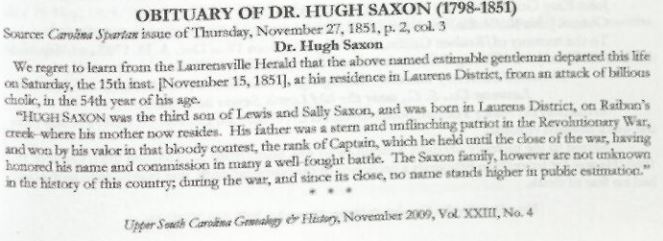
Lewis Saxon (captured). Taken prisoner at Hayes Station, according to William Blakely and Joseph Griffin. Appointed captain in 1781 and served to the end of the war. He is probably the “Captn. Saxon” in Burke’s letter. (W21791)
Joseph Griffin (probably not present). He served in Col. Hayes’s regiment from November 1780 to January 1782 (S21247). In 1845 he swore that his comrade Lewis Saxon “was taken a prisoner at Hayes’ Station in Ninety Six District” (W21791), but he never says he was there himself. Robert Long remembered him as away on an express, and one modern account wrongly lists him among the dead.
John “King” Cummins (spared). Named with Tinsley and Dunlap as survivors by O’Neall and Chapman (via Wood).
Reuben Golding (spared, unverified). Said to have been set aside by Cunningham, “to whom he was indebted for some past favors” (GoldenGenealogy.com).
William Irby (unverified tradition). A brother of Joseph Irby, Jr. and Greaf Irby, he is said to have been away fetching water when the station fell, and so survived.
Robert Hanna said in his 1820 petition that he “was at [Hays’] Station [with] Harris.” We have not established whether he was there on the day of the massacre.
Aftermath
Burial. Hugh O’Neal, owner of O’Neal’s Mill, watched from a nearby ridge and slipped away. The raiders spent the night at his mill and burned it the next morning, 20 November. When they had gone, O’Neal and his neighbors went to the station, identified the dead as best they could, and buried them in two mass graves (Wood).
The raid goes on. On 20 November Cunningham caught and killed Capt. Samuel Moore, whom Gen. Andrew Pickens had sent after him. Col. Levi Casey took command of the Little River Regiment.
The widows. Mrs. Hayes’s claim carries a note from J. E. Calhoun: “Mrs. Hays is a lady very much distressed, lost every thing by the Tories & Colo. Hays killed himself [was himself killed] — I think this a just Acct.” (SC21).
The hanging of Matthew Love, 7 December 1784. Love, a local man who had ridden with Cunningham, walked among the fallen at Hayes Station and ran his sword through anyone who still showed signs of life. After the war he came back to the Ninety Six district. He was arrested and brought before Judge Burke, but the court ruled that the peace treaty protected him, and he was discharged. That evening “the fathers, Sons, & brothers and friends of the slain prisoners” took him to the edge of a wood and hanged him. When Love protested that he was being killed without a trial, they reminded him “that he should have thought of that, when he was slaughtering their kinsmen.” (Burke’s letter)

The Monuments
The Original 1858 Monument
The first monument, of marble, was erected in 1858. Local stories disagree about what became of it. Some say lightning struck it, others blame vandals. Either way it ended as a pile of marble rubble, and that is now long gone.
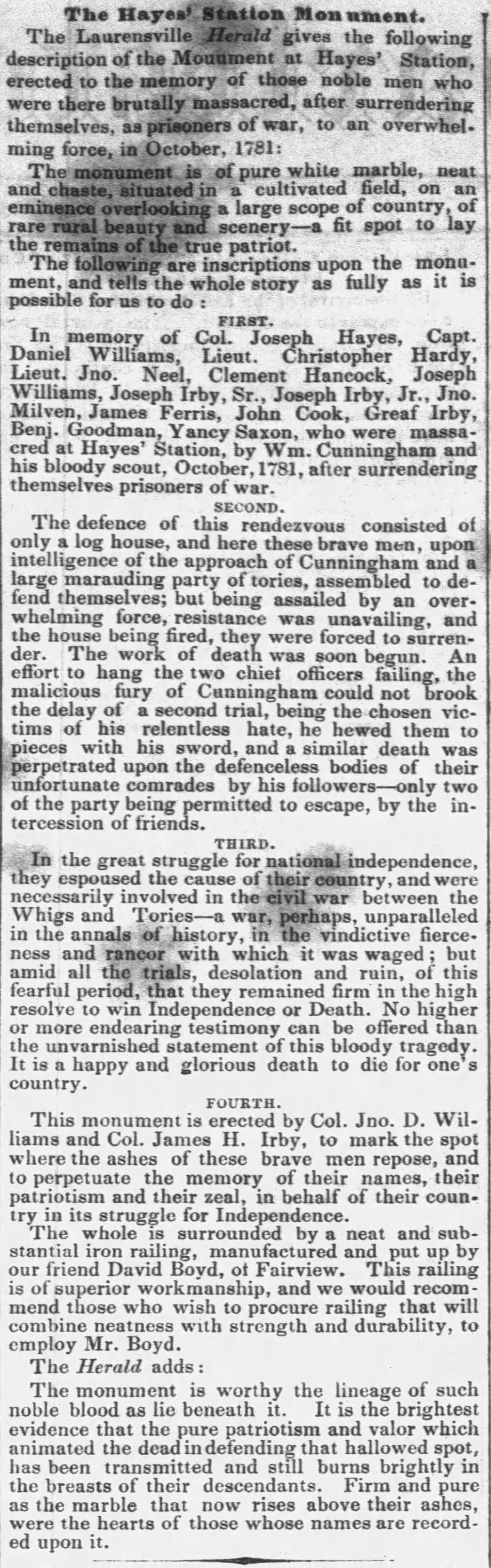
Hayes Station Old Monument, The Charleston Daily Courier (Charleston, South Carolina), 1858, via Newspapers.com
The 1910 DAR Monument

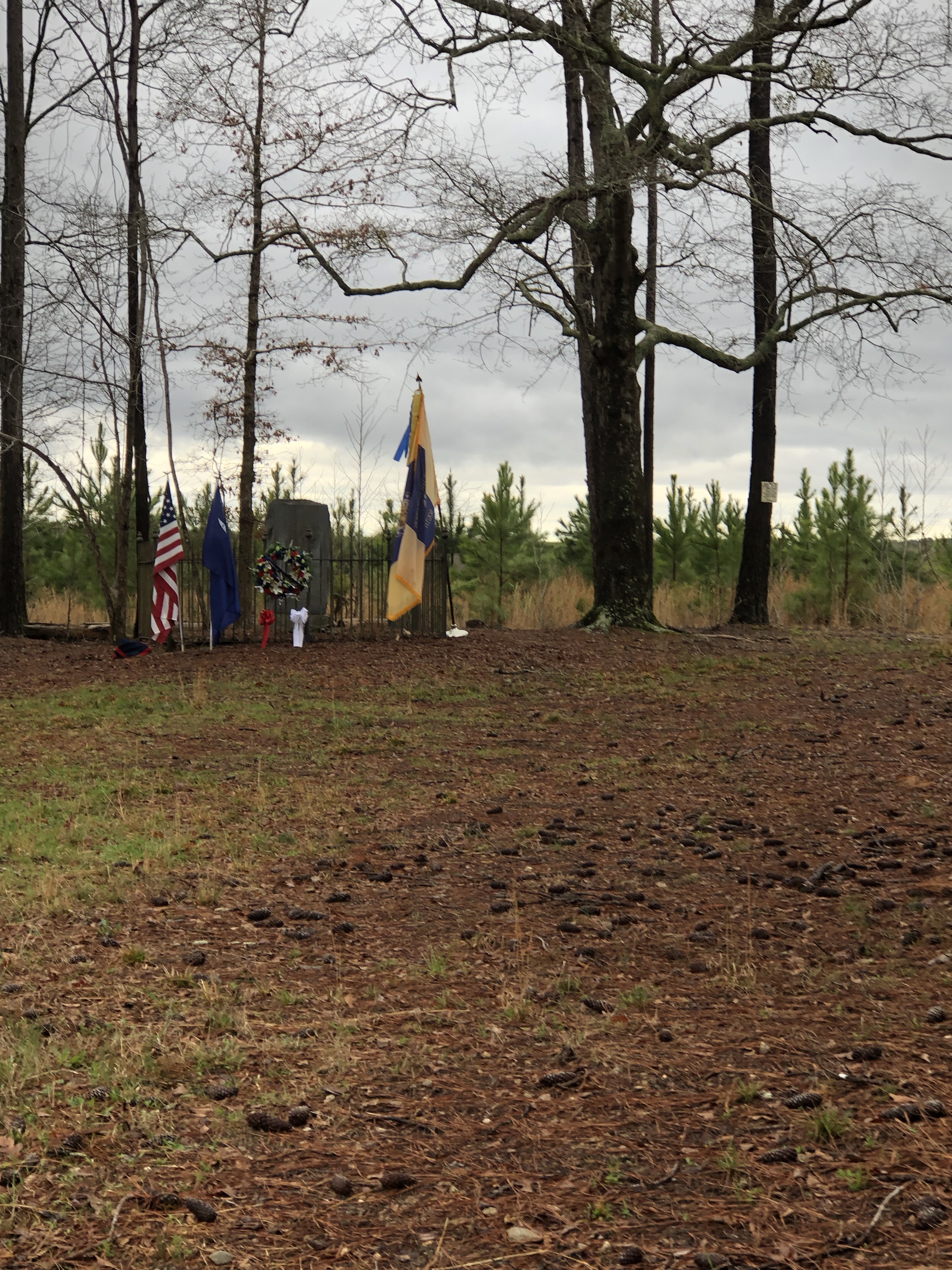
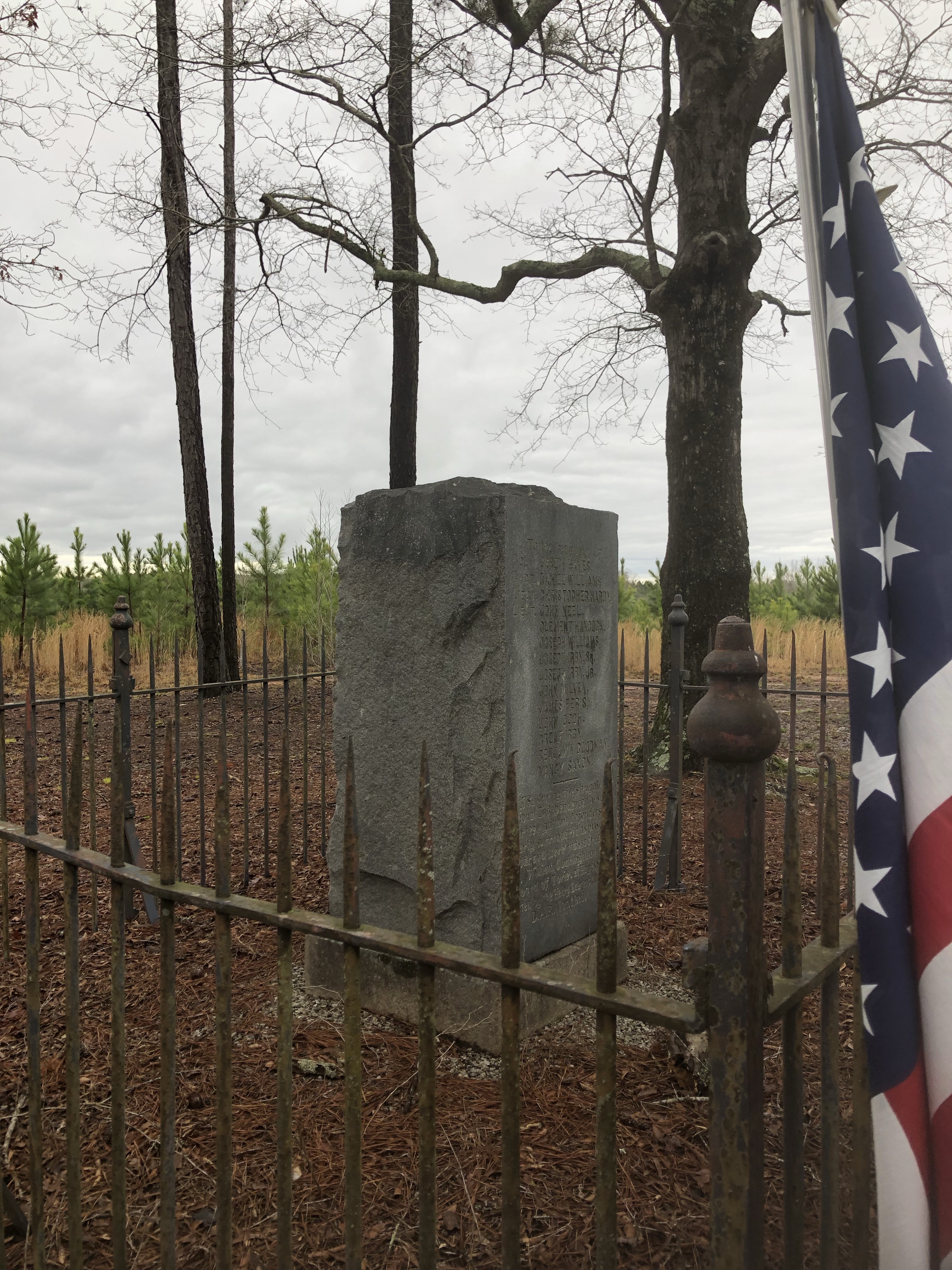
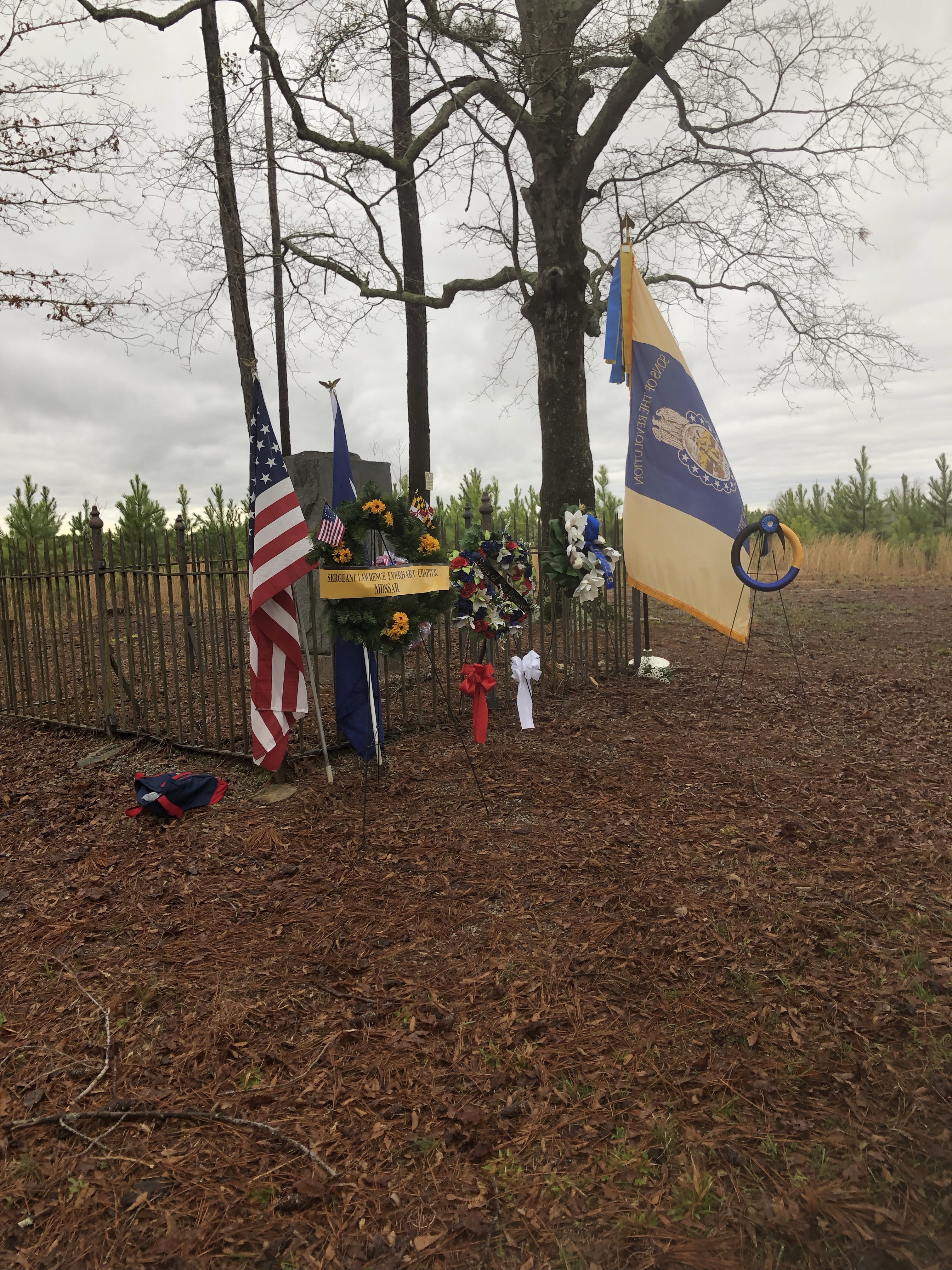
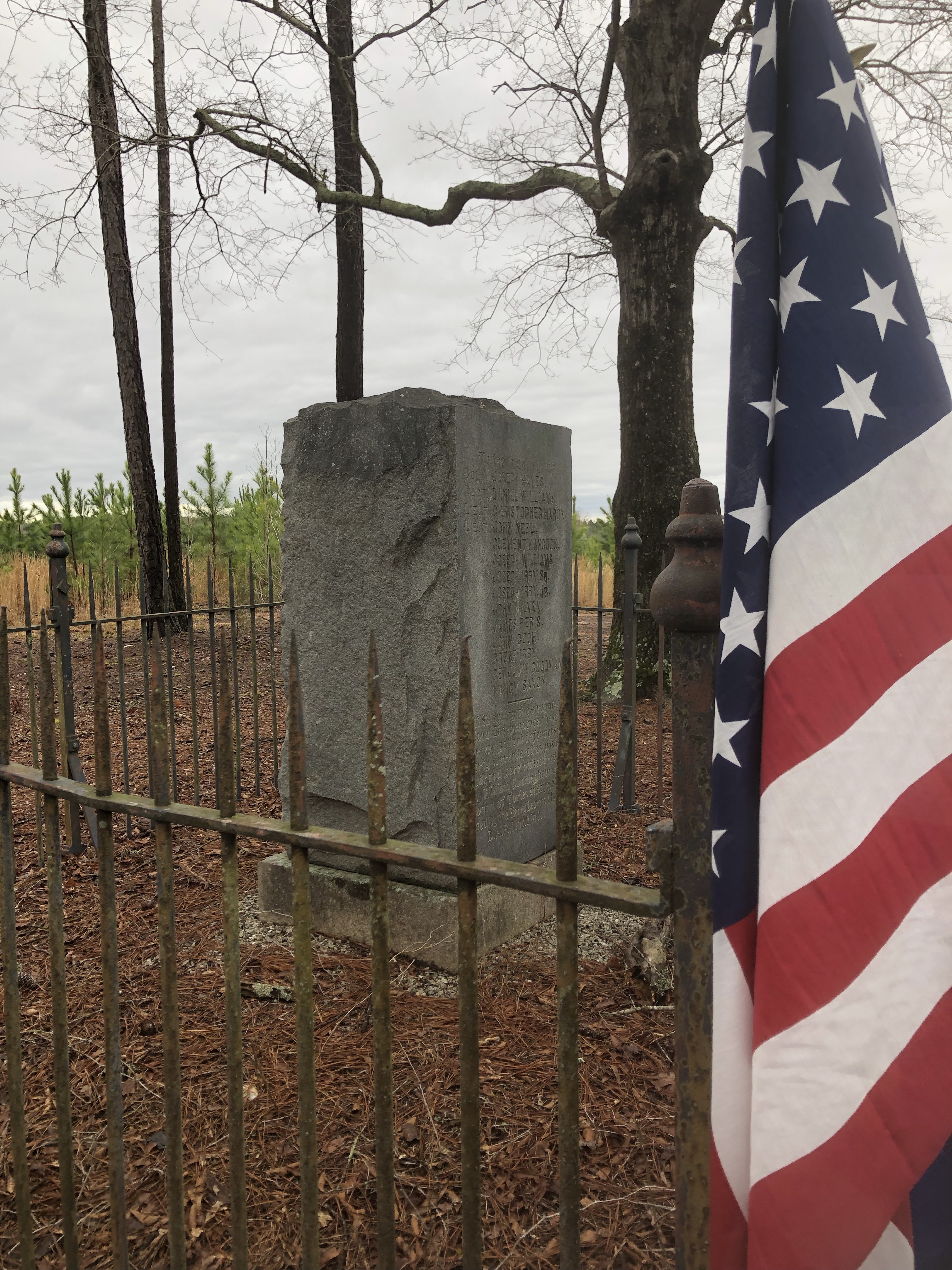
The Henry Laurens Chapter of the Daughters of the American Revolution erected the present monument in 1910 to replace the 1858 stone. It reads “To the Memory of” the fourteen men listed in The Fallen. The inscription at the bottom reads:
“In 1781 during the struggle for National Independence, these fourteen gallant defenders of Liberty surrendered as prisoners and were massacred by Maj. Wm. Cunningham and his band of Tories at Hayes Station”

Hayes Station Massacre 1921 article, 28 Aug 1921, The Index-Journal (Greenwood, South Carolina), via Newspapers.com
Hayes Monument, 1924, 3 Aug 1924, The Greenville News (Greenville, South Carolina), via Newspapers.com
In Their Own Words: Robert Long’s Statement, 1843
This statement of Robert Long, of Laurens District, “made evidently in 1843,” is from the papers of Dr. John H. Logan. It was printed in the Historical Collections of the Joseph Habersham Chapter, Daughters of the American Revolution, Vol. III (1910). Read more about Robert Long of the Little River Regiment. (Transcription at Genealogy Trails)
“Cunningham told Hayes’ men that if they would come out of the house and lay down their arms, they should be treated as prisoners of war. After some consultation, they complied. Cunningham marched them out into the old field, and after attempting to hang two on a stock pole, which broke, ordered them to sit down on the ground, took his sword and went to hacking them up and down until his fiendish malice was satisfied with the groans of the mangled and dying, when he told his men to complete the bloody work. Jos. Griffin, who belonged to Hayes’ company of forty men stationed there, had been sent off on an express the previous day. The house had been fired, and they were compelled to yield.”
“When Cunningham had selected Col. Hayes and Daniel Williams to be hung, on the fodder-stack pole, Joseph Williams said, ‘Brother, what shall I tell mother when I go home?’ ‘You d-d young rebel, you shall tell her nothing,’ and instantly cut him down.”
Visits and Photographs
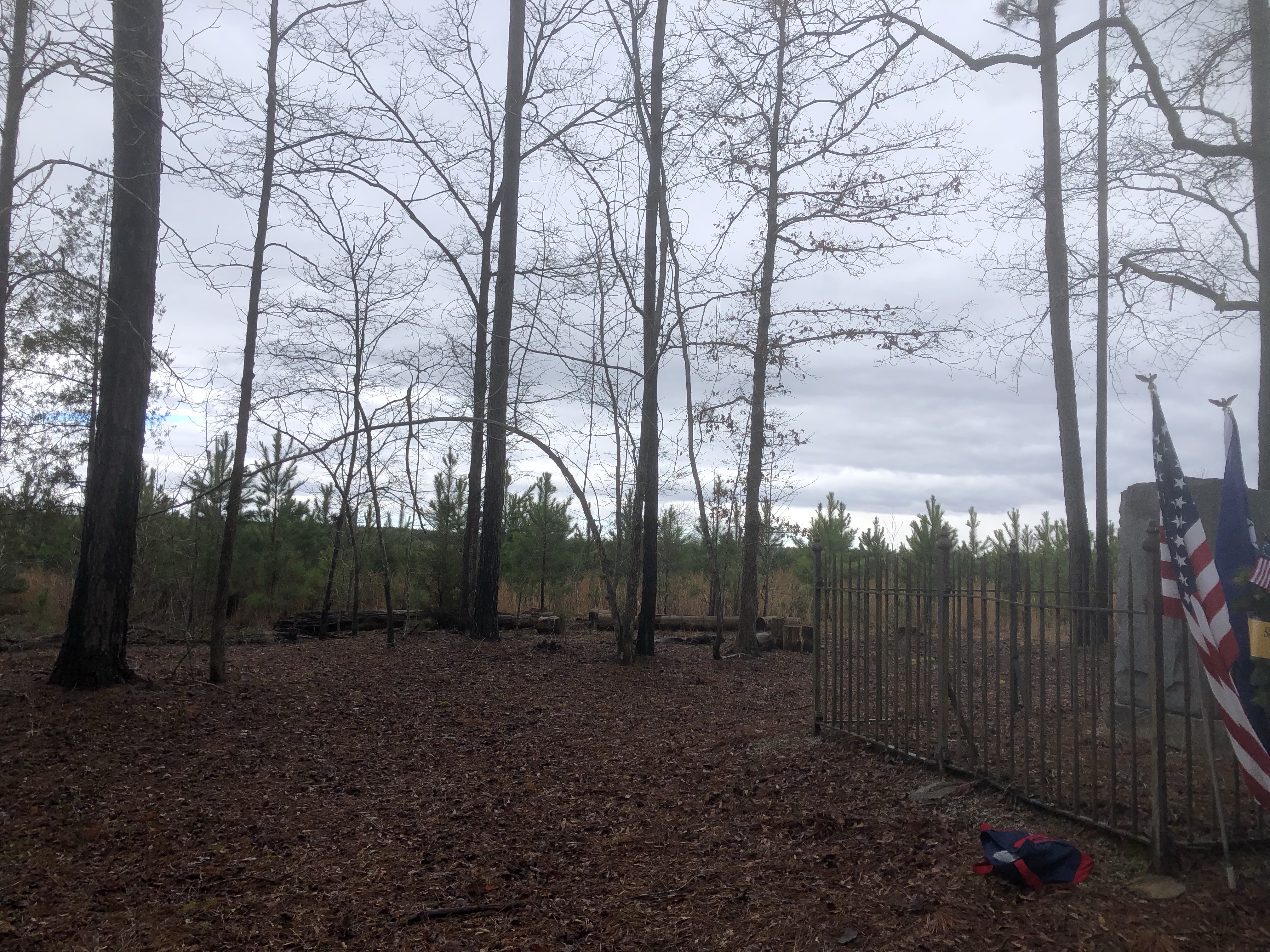
Read about my visits: Visiting Hayes Station (March 2022) and Hammond’s Old Store and Hayes Station, August 6, 2022. Hayes Station’s caretaker is Durant Ashmore.

Searching for the Dead
From the Laurens County Advertiser, February 2021: Cadaver Dogs, Historians Search for the Dead at Hayes’ Station in Laurens County. Beyond the monument, brothers Clayton and Kevin Broome of Spartanburg found many iron signals, possibly from the station and its blacksmith shop.




William “Bloody Bill” Cunningham: Clash of the Commanders: Villains (video)
More Photos


Sources
- Aedanus Burke to Gov. Benjamin Guerard, 14 Dec. 1784, Governor’s Messages No. 313, SC Department of Archives and History. Printed in Michael E. Stevens, “The Hanging of Matthew Love,” South Carolina Historical Magazine 88, no. 1 (Jan. 1987).
- David Ramsay, History of the Revolution of South-Carolina (1785), as quoted in J. B. O. Landrum, Colonial and Revolutionary History of Upper South Carolina (1897), pp. 349–350.
- Pension applications, transcribed by Will Graves and C. Leon Harris at Southern Campaigns Revolutionary War Pension Statements: James Tinsley S21426; John Mangum S16939; William Millwee W9200; Lewis Saxon W21791; James Dillard S6797; Robert Long S7157.
- South Carolina Audited Accounts: Joseph Hayes (AA 3461 / SC21), Daniel and Joseph Williams (AA 8541), Christopher Hardy (SC3590), Clement Hancock (SC3554), the Irbys (SC4190–4192), Benjamin Goodman (SC3208).
- Statement of Robert Long (1843), Logan papers, in Historical Collections of the Joseph Habersham Chapter, DAR, Vol. III (1910).
- Terry W. Lipscomb, Names in South Carolina, Vol. XXIV (Winter 1979), p. 37.
- Dr. Frank Wyman, “Commemorating the Massacre at Hayes Station and the Little River Regiment,” Southern Campaigns of the American Revolution, Vol. 1, No. 3 (Nov. 2004).
- Paul Ariel Wood, Jr., Bloody Bill Cunningham (South Carolina 250 Commission, 2026), chapter “More ‘Mellancholy Circumstances’: From The Ridge to Hayes Station.” Wood also cites John Belton O’Neall and John A. Chapman, Annals of Newberry.
- Hayes Station, Life, Liberty, Laurens.
- Artwork by Jorge Perez-Rubio, courtesy of the Laurens County Museum.
- Hayes’ Station, Carolana.com. Scroll to the bottom of that page for a list of known participants on both sides.
Open Questions
- 17, 18 or 19 November? The Williams brothers’ loss claim is headed “Lost at Colo. Hays Station Novr 18. 1781.” Gen. Pickens certified Col. Hayes’s duty “until the 19th Day of November 1781 Inclusive.” Both documents are contemporary. The 2013 SAR marker at Musgrove Mill gives November 17, and the Musgrove Mill visitor center map gives November 19.
- Fourteen, seventeen, or nineteen? Ramsay and the monument say fourteen were killed after the surrender. William Dunlap, who survived, said “Seventeen persons were killed including Colo. Hays and Lieutenant Neill” (W2723). Burke says nineteen. Who were the others?
- Fodder pole or tree limb? Burke says Hayes was hanged from “the limb of a tree” and then shot. Long and later writers describe a fodder-stack pole that broke.
- Who gave the warning? William Caldwell (Wood), an unnamed rider (Wyman), or Capt. John Owens (Carolana)?
How You Can Help
Some details on this page are marked unverified: the tavern and stage-coach stop, Capt. John Owens’s warning, the reason John Mangum was spared, Reuben Golding’s release, and William Irby’s escape. They are widely repeated, but we have not yet found a period source for them. If you have a document, family record, or reference that confirms or corrects any of them, or if you descend from someone who was at Hayes Station, please get in touch. Every new piece of evidence helps.
Related pages: The Little River Regiment · Honor Roll · Laurens County Rev War Timeline · Hammond’s Old Store · Robert Long · Rev War Sites of Laurens County
Elsewhere: Hayes Station at Life, Liberty, Laurens · Life, Liberty, Laurens · SC Battleground Preservation Trust