The Battle of Kings Mountain
7 October 1780
Kings Mountain, in present-day Cherokee and York Counties, South Carolina, near the North Carolina line

At a Glance
- When: afternoon of 7 October 1780, about seven weeks after Musgrove Mill.
- Where: a rocky, wooded ridge just south of the North Carolina line, now Kings Mountain National Military Park.
- Patriots: about 910 militia, among them Col. Isaac Shelby, Col. William Campbell, Col. John Sevier, Col. Benjamin Cleveland, Maj. Joseph McDowell, Col. Edward Lacey, Col. William Hill, Maj. William Chronicle and Col. James Williams of the Little River Regiment.
- Loyalists: about 1,125 Loyalist militia and Provincials under Maj. Patrick Ferguson.
- Result: a complete Patriot victory in about an hour. Ferguson was killed and nearly his whole force was killed, wounded or captured.
- For Laurens County: Col. James Williams was mortally wounded near the end of the fight and died the next day.
On This Page
- The Battle
- The Numbers
- The Death of Col. James Williams
- The Little River Regiment at Kings Mountain
- The Monuments
- Sources, Open Questions, and How You Can Help
The Battle
In September 1780 Maj. Patrick Ferguson, marching on the western flank of Lord Cornwallis’s army, sent word over the mountains that if the backcountry men did not lay down their arms he would “lay their country waste with fire and sword.” Instead the Overmountain men gathered at Sycamore Shoals and came after him, joined on the way by militia from North and South Carolina, among them Williams and his Little River men.
Ferguson fell back toward Cornwallis and made his stand on Kings Mountain, a narrow, wooded ridge. On the afternoon of 7 October the Patriots surrounded it and fought their way up the slopes from every side, falling back from bayonet charges and coming on again. After about an hour Ferguson was shot from his horse and killed, and his men surrendered. Some Patriots kept firing after the white flags went up, crying “Tarleton’s Quarter,” before their officers could stop them.
Cornwallis gave up his first invasion of North Carolina and pulled back into South Carolina. It was the turning of the war in the South.
Videos
What They Said
“This brilliant victory marked the turning point of the American Revolution.”
Theodore Roosevelt, The Winning of the West
“The turn of the tide of success.”
Thomas Jefferson
“This is a place of inspiring memories. Here less than a thousand men, inspired by the urge of freedom, defeated a superior force entrenched in this strategic position. This small band of Patriots turned back a dangerous invasion well designed to separate and dismember the united Colonies. It was a little army and a little battle, but it was of mighty portent. History has done scant justice to its significance, which rightly should place it beside Lexington, Bunker Hill, Trenton, and Yorktown.”
President Herbert Hoover, at Kings Mountain, 7 October 1930

The Numbers
| Patriots | Loyalists | |
|---|---|---|
| Strength | about 910 | about 1,125 |
| Killed | 28 | 157 |
| Wounded | 62 | 163 |
| Captured or missing | 0 | 698 |
The Death of Col. James Williams
Col. James Williams of the Little River Regiment had helped win at Musgrove Mill seven weeks before. He came to Kings Mountain in the middle of a bitter quarrel with Thomas Sumter over rank. The State (1954) has him riding to the head of his column with a shout: “Come on, my boys, the old wagoner never yet backed out!”
Williams’s sons were with him on the hill. Find a Grave names James Jr., Daniel, John and Joseph; the Williams family profile on WikiTree, following John Belton O’Neall’s Annals of Newberry (1859), names Daniel and Joseph.
Near the end of the battle Williams was shot. Thomas Young found him “on the top of the mountain, in the thickest of the fight,” and remembered his last words, spoken to his boys:
“For God’s sake, boys, don’t give up the hill!”
O’Neall’s account adds that his horse had been shot through the mouth and was “covering his rider with blood and foam.” Williams had turned to cheer his men on when a ball fired from the heights above struck him “just between his shoulders, and ranged downward through his body.” He fell within a few feet of Ferguson. Dying, he asked about his enemy; told that Ferguson was dead, he said, “I die contented.”
Who fired the shot is not certain. Wayne Lynch, in “The Death of a Patriot at Kings Mountain” (Journal of the American Revolution, 2014), sets out the stories: a pension applicant said Williams was killed by Tories after the British raised the flag of surrender; Col. William Hill hinted that one of Lacey’s own men did it, men who “had been heard to promise on oath that they would do it”; and an 1823 newspaper claimed Ferguson himself shot Williams.
His men carried him with them when they marched off. He died on 8 October in the arms of his young son, by family tradition Daniel. A 1954 story in The State (Columbia) says he was “buried in a raw cowhide near the mouth of Buffalo creek,” and that he was “spoken of as ‘Old King’s Mountain Jim.'” They had meant to carry him home to Ninety Six District. He never made it home to Mary.
Thomas Young of Union District, who ran to Williams as he fell, left him “in the arms of his son Daniel” (Young, “Memoir,” Orion, 1843). Young also remembered sleeping beside the colonel’s younger son Joseph in the woods the night before the battle. Read Joseph Williams’s story on the Honor Roll.
Tradition says the brothers’ first worry was who would tell their mother. According to the WikiTree profile, Daniel and Joseph wrote to her on 13 October: their father had been wounded on the 7th, died on the 8th and been buried with honors on the 9th.
Thirteen months later Daniel and Joseph were killed by Bloody Bill Cunningham’s men at Hayes Station. The sources give their ages at Kings Mountain as 17 and 13, or 18 and 14.
The Lost Commission
For several weeks no one in authority knew Williams was dead. In that time Gov. John Rutledge commissioned him a brigadier general; the commission could not be delivered. Carolana calls him “the first brigadier general commissioned by the South Carolina civil authorities after the Fall of Charleston.” In 2005 the South Carolina General Assembly confirmed the rank, 225 years later, and renamed the Little River bridge the James Williams Memorial Bridge. It marks the northeast corner of what was his plantation.
Dug Up in 1898
Williams’ grave was found again in 1898, and not treated gently. The Laurens Advertiser reprinted this from the Yorkville Yeoman:
“Several days ago a party of men consisting of A. G. Mintz, Rev. Mr. Bailey, J. E. Mintz, J. H. Mintz, Lee Broom, F. L. White and several others opened the grave of Colonel Williams, who was seriously wounded at the battle of King’s Mountain and was carried by the Americans on their retreat eastward, back across Broad River. That night he died and was buried on a hill near the intersection of Buffalo Creek and Broad River. His bones were found in a good state of preservation and were all removed except the skull, which are hidden away for a future funeral. Mr. A. G. Mintz was exhibiting the skull on the streets of Blacksburg. It is proposed that his remains be buried in Berkley Park at Blacksburg and a monument be erected over them.”
Yorkville Yeoman, in The Laurens Advertiser (Laurens, South Carolina), 17 May 1898, page 3
The bones were kept out of sight for several years. The 1954 story says the DAR had them “placed in an iron chest, removed to Gaffney, and deposited in the front yard of the Gaffney Carnegie Library,” under a granite marker “surrounded by two small cannons and some cannon balls.” Other accounts place the grave on the lawn of the Administration Building on Limestone Street. The Daughters of the American Revolution monument and plaque mark it today (National Park Service).

The Little River Regiment at Kings Mountain
These Little River men are on our Honor Roll and are named among Williams’s officers at Kings Mountain:
- Col. James Williams, mortally wounded
- Lt. Col. Joseph Hayes, killed at Hayes Station in 1781
- Capt. James Dillard, husband of Mary Ramage Dillard
- Capt. Thomas Dugan (Duggin)
- Capt. Daniel Williams, the colonel’s son
The other side of the hill had Little River men too. The park’s map of Ferguson’s Tory regiments shows a Little River Loyalist militia among them. Neighbors from what is now Laurens County fought each other on that ridge.


Maj. Samuel Hammond also fought at Kings Mountain, with a different unit. That December he led the Patriots at Hammond’s Old Store.
A longer list of Williams’s officers is in Known Patriots at Kings Mountain (Carolana). We are checking those names against pension and audited-account records before adding them to the Honor Roll.
The Monuments
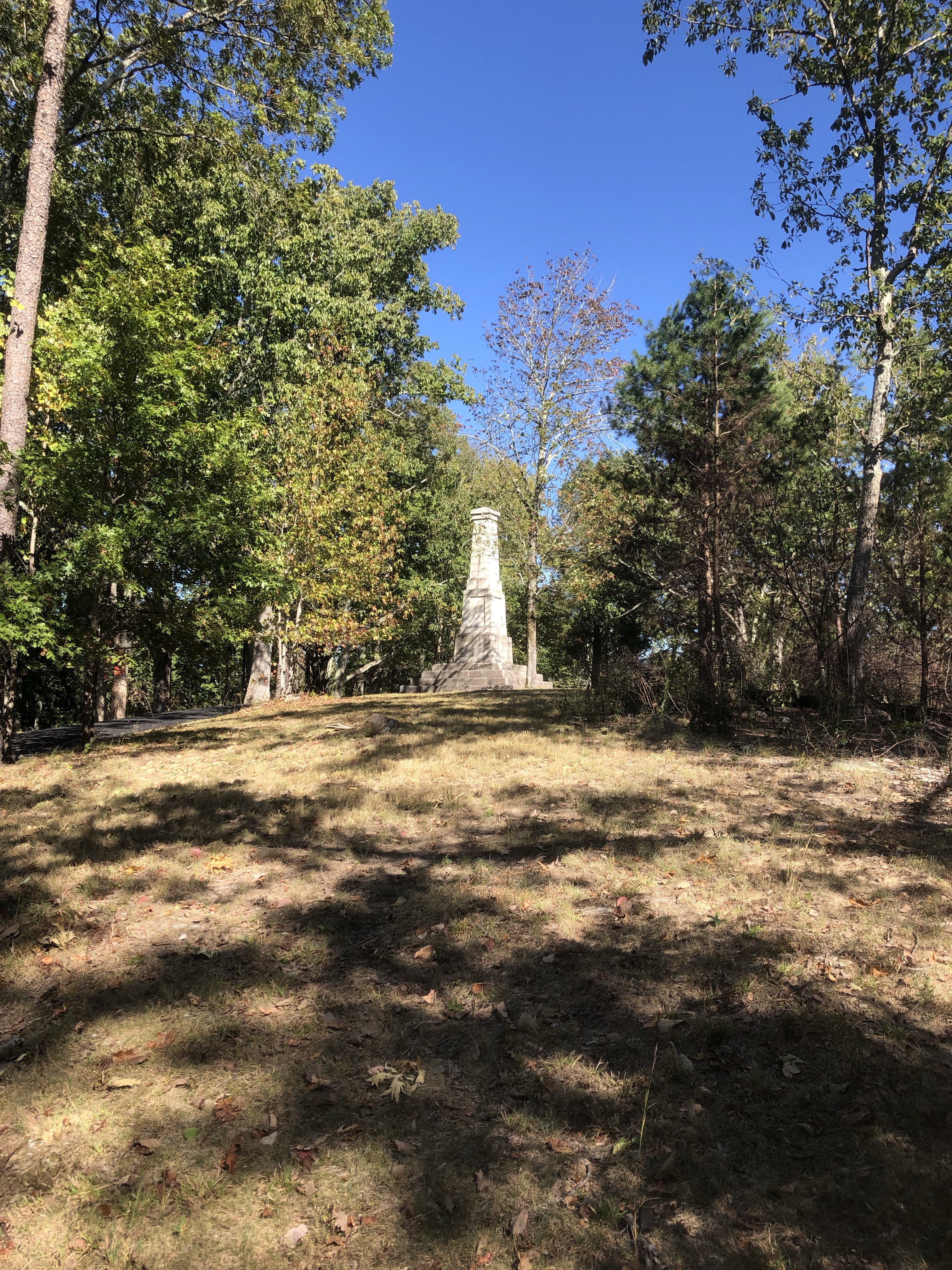
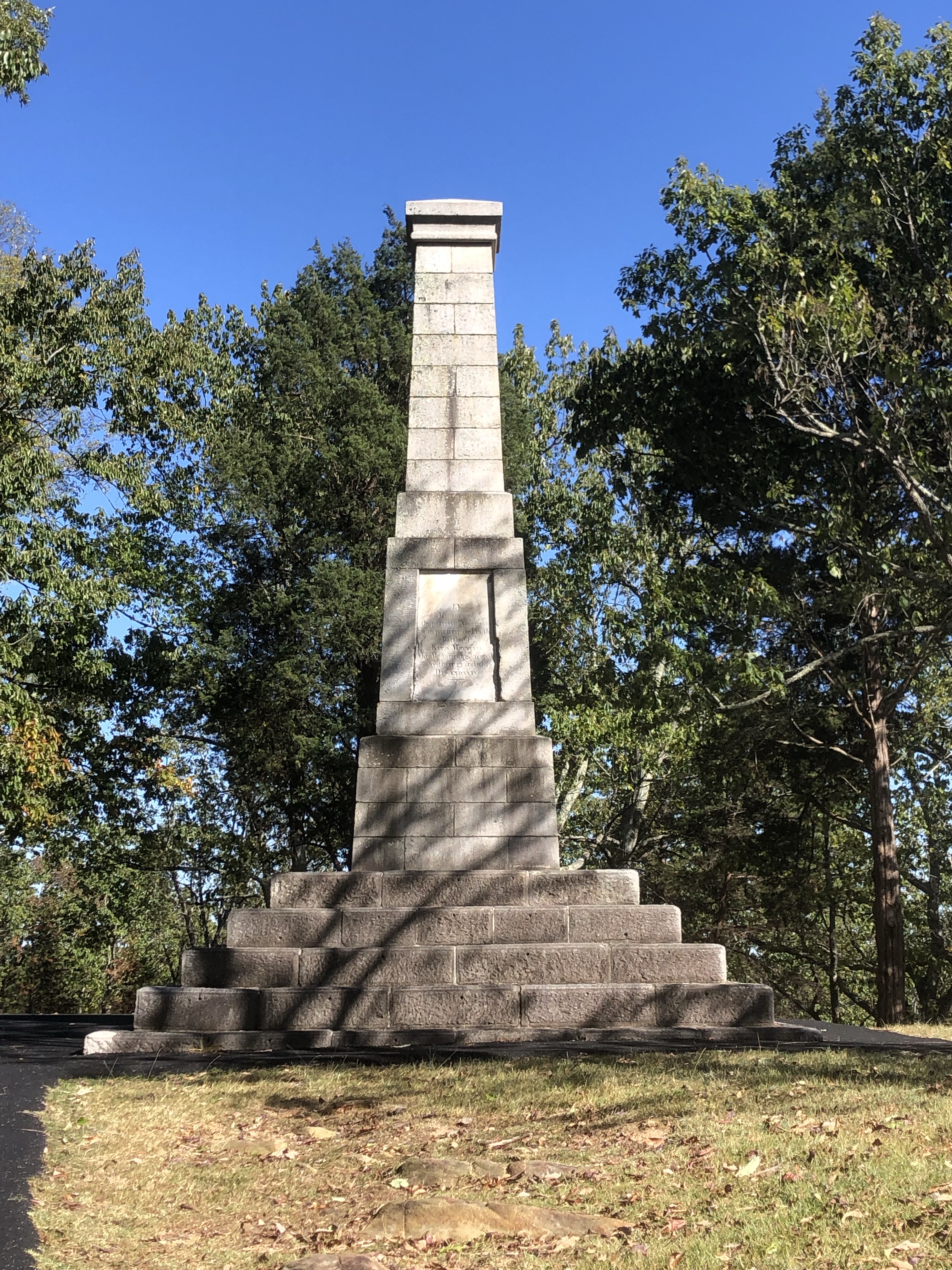
Several monuments stand along the ridge at Kings Mountain National Military Park. These photos are from my visits.
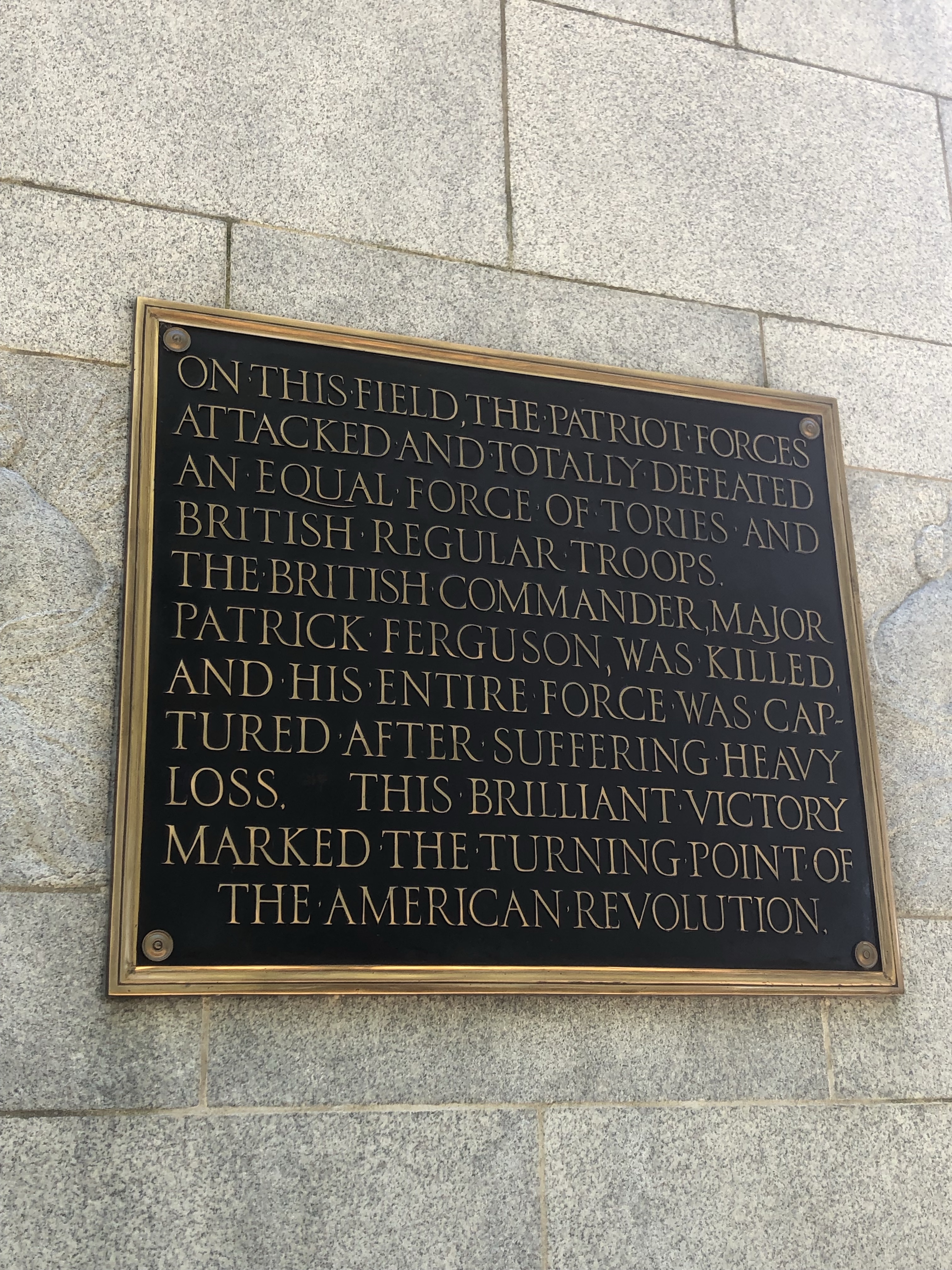
The Kings Mountain Monument (1909)

“To commemorate the victory of Kings Mountain, October 7, 1780, erected by the Government of the United States to the establishment of which the heroism and patriotism of those who participated in this battle so largely contributed.”
“On this field the patriot forces attacked and totally defeated an equal force of Tories and British regular troops. The British commander Major Patrick Ferguson was killed and his entire force was captured after suffering heavy loss. This brilliant victory marked the turning point of the American Revolution.”


Another plaque lists the American forces by where they were raised. The South Carolina line reads “Ninety Six District, S.C. … Colonel James Williams.”


The Centennial Monument (1880)

One marble panel reads:
“In Memory of the patriotic Americans who participated in the Battle of Kings Mountain this Monument is erected by their grateful Descendants.”
Another lists the officers and men who fell. Col. James Williams heads the list. The top lines are badly weathered:
“[Fe]ll on this battle ground in defence of Civil Liberty:
Col. James Williams
Maj. William Chronicle
Captains: John Mattocks, David Beatie, William Edmonson
First Lieutenants: Reece Bowen, Thomas McCulloch, William Blackburn, Robert Edmonson
Second Lieutenants: John Beatie, Andrew Edmonson, Humberson Lyon, James Corry, James Laird, Nathaniel Guist, Nathaniel Dryden, James Phillips
Privates: William Rabb, John Boyd, David Duff, Henry Henigar, William Watson, Arthur Patterson, Preston Goforth”


The Chronicle Stones
The oldest monument on the field was put up in 1815 by Dr. William McLean. The small, worn stone beside it is the original. The larger stone, placed in 1914 by the Kings Mountain Association of Yorkville, repeats its words:
“Sacred to the memory of Major William Chronicle, Captain John Mattocks, William Rabb and John Boyd, who were killed at this place on the 7th of October 1780, fighting in defense of America. Colonel Ferguson, an officer of his Britannic Majesty, was defeated and killed at this place on the 7th of October 1780.”


Ferguson’s Grave
Ferguson was buried where he fell, under a cairn of stones. Visitors still toss stones onto the pile, for opposite reasons. Some follow the Scottish custom of adding a stone to honor the dead, or for luck. Local folklore says Patriot sympathizers threw rocks on the grave to mock his defeat and “keep his ghost from roaming the ridgeline.” The pile grows so large it has to be cleared from time to time, and the cycle starts again.
The marker was placed on the 150th anniversary, the same day President Hoover spoke:
“To the memory of Col. Patrick Ferguson, Seventy-First Regiment, Highland Light Infantry. Born in Aberdeenshire, Scotland in 1744. Killed October 7, 1780 in action at Kings Mountain while in command of the British troops. A soldier of military distinction and of honor. This memorial is from the citizens of the United States of America in token of their appreciation of the bonds of friendship and peace between them and the citizens of the British Empire. Erected October 7, 1930.”

The Visitor Center
A display in the visitor center lists the commanders. Williams’s card reads “Mortally wounded. Commanded 30 Patriot Militia from South Carolina.”


More Photos






Sources and Resources
- Kings Mountain, American Battlefield Trust
- Wayne Lynch, “The Death of a Patriot at Kings Mountain”, Journal of the American Revolution, 30 January 2014
- Col. James Williams and Known Patriots at Kings Mountain, Carolana
- James Williams Gravesite, National Park Service
- Yorkville Yeoman, reprinted in The Laurens Advertiser, 17 May 1898, p. 3
- “Col. James Williams, a Hero of Battle of King’s Mountain” and “A Regrettable Omission,” The State (Columbia, S.C.), 4 July 1954 (York County History Center clipping file)
- John Belton O’Neall, Annals of Newberry (Charleston: S. G. Courtenay & Co., 1859), via WikiTree, James Williams
- James Williams, Find a Grave memorial 54701368
- Theodore Roosevelt, The Winning of the West
- Kings Mountain Roster, York County SCGenWeb
- Kings Mountain National Military Park
- The Battle of Kings Mountain, Tennesseans in the Revolutionary War
- Battle of King’s Mountain Accounts, Cleveland County, NC Archives
- The Battle of King’s Mountain, TheAmericanRevolution.org
Open Questions
- Who shot James Williams? A Tory after the surrender, one of Lacey’s men, or Ferguson himself? See Lynch’s article.
- Where was he first buried? Near the mouth of Buffalo Creek on the Broad River (1898 and 1954 newspapers, NPS), or on Loyalist Mathew Fondren’s plantation at Camp Creek, early on 9 October (O’Neall, via WikiTree)?
- Which sons were with him? Daniel and Joseph (O’Neall), or James Jr., Daniel, John and Joseph (Find a Grave)? And who held him when he died?
- When was he reburied in Gaffney? His bones were dug up in May 1898 and “kept secret for several years.” We have not found the date of the reburial.
- Which other Little River men were at Kings Mountain? Carolana names many more of Williams’s officers. Which of them can be confirmed from pension or audited-account records? See the Honor Roll.
How You Can Help
Do you descend from a man who fought at Kings Mountain under James Williams? Do you have a pension application, a family Bible or letters that place him there? Please get in touch.
Descendants of the men who served under Col. Williams may also want to know the General James Williams Chapter of the South Carolina Society, Sons of the American Revolution, named in his honor.
Related pages: Musgrove Mill · Little River Regiment Honor Roll · Hayes Station · Mary Ramage Dillard · Hammond’s Old Store · Laurens County Rev War Timeline · Rev War Sites of Laurens County