Mary Ramage was born in 1757 to John Ramage and Jean Adair. She married Revolutionary War Patriot Little River Regiment Captain James Dillard. They had a homestead on the Enoree River known as Pleasant Hill. She died in 1795, probably during childbirth. Captain Dillard had seven children with Mary Ramage, and seven children with second wife, Mary Puckett.
There is a plethora of Mary stories, some are based on fact. Many are based on family lore that has been embellished over time. Many are just plain wrong, and are a confusing mash up of different people, and different stories.
James and Mary Ramage Dillard did have a homestead in the eastern section of Laurens County, SC. Mary is considered to be a Revolutionary War heroine because of her intelligence gathered and shared prior to the Battle of Blackstock’s.
Legend has Mary leaving a baby son behind at home, either tied to or left with a bed post holding his dressing gown tight, keeping the sleeping baby safe while Mary rode with her warning.
Her effort is said to have help prevent a Tarleton victory at Blackstock’s, which was his first defeat in South Carolina. Tarleton later recalled seeing a woman on horseback in the forest bordering his march, and he believed that she reported to Sumter.
There are tales of the family home being burned to the ground more than once during these times of neighbor vs neighbor, and retribution. It is also said that Mary would watch – and count – passing units of enemy soldiers, and would report those counts back to the local militia leaders.
Mary is also known to accompany her husband at times, as a camp follower. She is said to have been with her husband at Cowpens, Ninety-Six, and King’s Mountain.
Tarleton’s Account
This fascinating reference is from Banastre Tarleton himself. (Note Tarleton’s habit of referring to himself in the third person). The full book can be accessed via the title link.

“A woman on horseback had viewed the line of march from a wood, and, by a nearer road, had given intelligence that the British were approaching without infantry or cannon.”

“…and being informed of Tarleton’s approach and want of infantry, by a woman who passed him on the march, and contrived by a nearer road to get to them…”
From – “A history of the campaigns of 1780 and 1781, in the southern provinces of North America” by Lieutenant-General Banastre Tarleton, 1754-1833.
Publication date 1787
https://archive.org/details/historyofcampaig00tarl/page/176/mode/2up
The woman on horseback was Mary Ramage Dillard – the warning was to Sumter at Blackstock’s Plantation, November 20th, 1780.
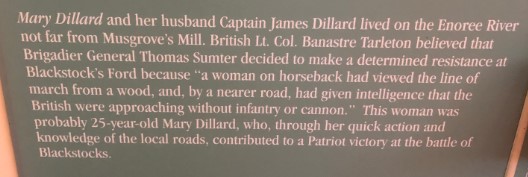
The plaque above is from a storyboard in the visitor center at Musgrove’s Mill State Historic Site.
From the State Park Blackstock’s Battlefield website:
“After learning of Tarleton’s advance, Sumter ordered his force to begin a retreat toward the Tyger River. In an attempt to catch the Patriots, Tarleton left his slow-moving infantry and cannon behind and rushed ahead with just his mounted troops. Learning of this from a local woman, Mary Dillard, Sumter decided to stand and fight late in the day at the farm of William Blackstock on the banks of the Tyger River.”
https://southcarolinaparks.com/blackstocks-battlefield
Mary Ramage Dillard Narrative
Mary Ramage, a daughter of John and Jean (Jane) Ramage of Laurens County, South Carolina, was born during the early 1760’s. Mary married James Dillard (4 February 1755-4 December 1836), who later became an American Revolutionary Captain. Capt. James Dillard was a son of George Dillard (ca. 1735-3 March 1790) and Priscilla Majors. Capt. James and Mary Ramage Dillard settled near the South Fork Creek in what is now Laurens County, South Carolina (the eastern section).
History records that Mary Ramage Dillard was a remarkably little and beautiful woman. Mary was a member of a family who supported independence during the American Revolution. Both Mary’s father, John Ramage, and her husband, Capt. James Dillard fought for American independence during the Revolution. Capt. James and Mary Ramage Dillard had a large home on the Enoree River, opposite the Musgrove plantation. On two occasions, Capt. James and Mary Ramage Dillard’s home was burned by the British and/or Tories but this did not discourage their desire for American independence.
Mary Ramage Dillard is considered an American Revolutionary Heroine because of her midnight ride to warn the Patriots of an impending attack. It seems that Mary’s husband, Capt. James Dillard, was away from home serving in the militia at the time. A group of British and Tory Soldiers came to the Dillard home and ordered Mary to prepare a meal for them. While serving the meal, Mary overheard them discussing that they would attack the Americans. After they left, Mary mounted her horse not even taking the time to saddle it and carried the information to the Patriots. Her effort is said to have prevented a Tory victory at Blackstocks, Tarleton’s first defeat in South Carolina.
Tarleton later recalled seeing a woman on horseback among the trees bordering his march and he believed that she had reported him to Sumter. The Battle at Blackstocks occurred on 20 November 1780. There have been several versions of Mary Ramage Dillard’s ride. Several stories stated that Mary had warned Colonel Clarke at Green Springs of an attack by Ferguson and Dunlap. Another indicates that she warned General Greene at Musgrove Mill (19 August 1780). Historians now agree that she warned the Patriots at Blackstocks. Historians have come to this conclusion because the Tory troops were camped at Musgrove’s Mill and the Patriots were in camp at Blackstock’s Plantation.
In a letter written to Lyman Draper in 1873, Mrs. Nancy E. Dillard Boyce, age 71, daughter of Capt. James Dillard and his second wife, stated that the first wife of her father was Mary Ramage, the daughter of John and Jean (Jane) Ramage. Mrs. Boyce’s letter also identified Mary Ramage Dillard as the “Mrs. Dillard” who had warned Sumter at Blackstock’s on the Tyger River that British soldiers were headed in that direction. Mrs. Boyce also stated that her older sister had been of the opinion that the warning had been to Musgrove’s Mill (19 August 1780). Mr. Draper, author of Kings Mountain and Its Heroes which was published in 1881, noted on Mrs. Boyce’s letter that the British were already at Musgrove’s Mill at the time. One family story concerning Mary Ramage Dillard’s ride has been passed down from generation to generation among her Ray descendants of northeast Mississippi. Members of the family say that Mary Ramage Dillard’s son, John was only a small child at the time. Mary could not take him with her and had no one to leave him with. She lifted up one end of the bed and set the bedpost down on the end of the child’s nightshirt where she left him in order to warn the patriots. The British came to Dillard home, finding the child they took him to a nearby home before returning and burning the Dillard home.
On another occasion, Mary numbered the British Army while they marched down a road near her home. By counting the men in each file and then counting the number of files, she was able to calculate the number of British. She gave this information to her husband who passed in on the commander of the American Patriots.
• Mary Ramage Dillard died at the age of 35 in 1795. Capt. James Dillard later married Mary Puckett and they had seven children. The children of Capt. James and Mary Ramage Dillard were: John Dillard, Priscilla Ramage Dillard Garrett, Jane “Jennie” Dillard Burke, Elizabeth Dillard Harris, George W. Dillard, Samuel Dillard and Mary “Polly” Dillard Garrett.
Compiled by:
Martis D. Ramage, Jr.
Ruth Ramage McElhaney
Source: Genealogy of Mary Ramage Dillard
https://www.familysearch.org/en/memories/memory/2626680
Two Mary Dillards Confusion
Captain James Dillard was married twice – both times to a woman named Mary. Mary Ramage was his fist wife. Mary Puckett was his second wife.

from My People, by Thornwell Jacobs
Nancy Dillard, daughter of James and Mary Puckett, indicated that she did not even know there was a first Mary, prior to her own mother Mary, the second.
A marker to Mary Ramage Dillard was placed at Pleasant Hill Cemetery – in the wrong place, at Mary Puckett Dillard’s grave. Captain James Dillard is buried next to Mary Puckett Dillard, at Pleasant Hill. The marker for Mary Ramage Dillard was eventually moved to Duncan Creek Presybterian.


The actual resting place of Mary Ramage Dillard is unknown, she was probably buried at the Dillard home place. Mary Ramage Dillard is memorialized with a cenotaph stone at Duncan Creek Presbyterian Church. Many other Ramages from her family are also interred there.


Mary’s father John Ramage, and her grandfather Joseph Adair, Sr., were both Patriots with the Little River Regiment, and are also both interred at Duncan Creek Presbyterian. Both John Ramage and Joseph Adair Sr were signers of the Williams Petition.
Sarah Dillard’s Ride Confusion


“Sarah Dillard’s Ride – A Story of the Carolinas” in 1780 was published in 1898, written by James Otis.
While the depiction of Mary Dillard’s small frame, beauty, the ride, etc , how “Mary” became “Sarah” in this retelling is a mystery. The name Sarah may have been used for the book because of the two Mary Dillards confusion. How much of the book is fiction, and how much is fact is lost to history.
http://www.gutenberg.lib.md.us/4/3/8/0/43806/old/43806-h/43806-h.htm#i-128
Regarding the Sarah Dillard Book
…The book was part of a series called the Young Patriot Series that was used as text books for students of that time .It is an amazing tale that includes the boys meeting up with Capt. Dillard, Col. McDowell and Col. Campbell (all of these surnames are part of my own genealogy) and continuing on into battle.
I have never found the answer as to why she was called Sarah instead of Mary. Perhaps because Mary Ramage Dillard died in childbirth in 1795 and Capt. Dillard took another wife who was also named Mary (Puckett).The two have often been confused.
When the Eagle Scouts decided to make a memorial at the gravesites of Capt. (then Major) Dillard and his wife they mistakenly marked the gravesite of Mary Puckett as Mary Ramage Dillard. Unfortunately, I was unsuccessful in getting them or the SAR to make a stone for Mary Puckett Dillard even though they had turned hers and James Dillard’s face down in the dirt.
They are buried on the Duckett farm which is now private property. The Duckett family had two of their children marry Dillards including Lydia Duckett who married Samuel Dillard, my great great grandfather and his half sister, Narcissa Dillard, married Thomas Duckett. Thomas and Narcissa are buried behind James and Mary Puckett Dillard.
Source: Jody Dillard, February 6, 2010 at Genealogy.com
https://www.genealogy.com/forum/surnames/topics/dillard/2510/
Mills’ Statistics Confusion
The following was excerpted from The Women of The American Revolution, Vol. 1 by E. F. Ellet
“The recollection of the courage and patriotism of Mrs. Dillard is associated with the details of a battle of considerable importance, which took place in Spartanburg District, at the Green Spring, near Berwick’s iron works. The Americans here gained great honor. Colonel Clarke, of the Georgia volunteers, joined with Captains McCall, Liddle, and Hammond, in all about one hundred and ninety-eight men—having received intelligence that a body of tory militia, stated to be from two to five hundred, commanded by Colonel Ferguson, were recruiting for the horse service—determined to attempt to rout them. **
** Mills’ Statistics of South Carolina, p. 738.
They marched accordingly; and hearing that a scouting party was in advance of Ferguson’s station, prepared to give them battle. Colonel Clarke, with his forces, encamped for the night at Green Spring.
On that day the Americans had stopped for refreshment at the house of Captain Dillard, who was with their party as a volunteer. They had been entertained by his wife with milk and potatoes—the simple fare which those hardy soldiers often found it difficult to obtain. The same evening Ferguson and Dunlap, with a party of tories, arrived at the house. They inquired of Mrs. Dillard whether Clarke and his men had not been there; what time they had departed; and what were their numbers? She answered that they had been at the house; that she could not guess their numbers; and that they had been gone a long time. The officers then ordered her to prepare supper for them with all possible despatch. They took possession of the house, and took some bacon to be given to their men. Mrs. Dillard set about the preparations for supper. In going backwards and forwards from the kitchen, she overheard much of their conversation. It will be remembered that the kitchens at the South are usually separate from the dwelling-houses. The doors and windows of houses in the country being often slightly constructed, it is also likely that the loose partitions afforded facilities for hearing what might be said within. Besides, the officers probably apprehended no danger from disclosing their plans in the presence of a lonely woman.
She ascertained that they had determined to surprise Clarke and his party; and were to pursue him as soon as they had taken their meal. She also heard one of the officers tell Ferguson he had just received the information that the rebels, with Clarke, were to encamp that night at the Great Spring. It was at once resolved to surprise and attack them before day. The feelings may be imagined with which Mrs. Dillard heard this resolution announced. She hurried the supper, and as soon as it was placed upon the table, and the officers had sat down, slipped out by a back way. Late and dark as it was, her determination was to go herself and apprize Clarke of his danger, in the hope of being in time for him to make a safe retreat; for she believed that the enemy were too numerous to justify a battle.
She went to the stable, bridled a young horse, and without saddle, mounted and rode with all possible speed to the place described. It was about half an hour before day when she came in full gallop to one of the videttes, by whom she was immediately conducted to Colonel Clarke. She called to the colonel, breathless with eagerness and haste, “Be in readiness either to fight or run; the enemy will be upon you immediately, and they are strong!”
In an instant every man was up, and no moments were lost in preparing for action. The intelligence came just in time to put the whigs in readiness. Ferguson had detached Dunlap with two hundred picked mounted men, to engage Clarke and keep him employed till his arrival. These rushed in full charge into the American camp; but the surprise was on their part. They were met hand to hand, with a firmness they had not anticipated. Their confusion was increased by the darkness, which rendered it hard to distinguish friend from foe. The battle was warm for fifteen or twenty minutes, when the tories gave way. They were pursued nearly a mile, but not overtaken. Ferguson came “too late for the frolic;” the business being ended. Clarke and his little band then returned to North Carolina for rest and refreshment; for the whole of this enterprise was performed without one regular meal, and without regular food for their horses.”
https://babel.hathitrust.org/cgi/pt?id=hvd.hwynhe&seq=306
Jane Black Thomas and Mary Dillard
Mary’s story is often mixed up with the story of Jane Black Thomas. This mash-up below is from “The History of Edgefield County From the Earliest Settlements to 1897”. It is a recounting from the notes of Col. Samuel Hammond, having to do with the Battle of Cedar Springs.
“Mrs. Dillard, who had given our party milk and potatoes the day before this battle, stated that Ferguson and Dunlap, with their party of Tories came there on the next evening. They inquired after Clarke’s party their numbers, etc., and she gave them as little information as possible. They ordered her to prepare supper with dispatch; and while she was so employed, she heard one of the Tory officers tell Ferguson that he had just been informed that the rebels under Clarke were to camp that night at the Green, or Cedar Springs. It was immediately resolved to attack them that night, and Mrs. Dillard’s husband being with Clarke, she resolved to give them notice of it. As soon as she could set out the supper she slipped out to the stable, bridled a young horse, and, without a saddle, galloped off to apprise Clarke of his danger; under an impression that the enemy were too numerous to justify battle with them. She arrived just in time, for Dunlap had been sent forward by Ferguson, with orders to attack and detain us until he should come up with the remainder. Dunlap had advanced rapidly and charged soon after we had paraded and were ready for his reception. The lady returned home in safety and deserves well of her countrv.
The credit of giving this seasonable notice to the Americans has also been claimed for Mrs. Thomas, the heroic mother of Colonel J. Thomas, jun., and no doubt with reason — they both did it. With such patriotic matrons and with a peasantry who refused to take protection, or acknowledge submission to the British forces, well may this District be designated as Spartanburg.
Mrs. Thomas rode sixty miles to give Colonel Clarke the information. The foregoing should have appeared in the Sketch of Samuel Hammond and his Services, but was overlooked and inadvertently left out..”
https://www.carolana.com/SC/Counties/History_of_Edgefield_County_SC_Chapman_1897.pdf
Kings Mountain and Its Heroes


Full book available online here – “King’s Mountain and Its’ Heroes” by Lyman C Draper
https://www.google.com/books/edition/King_s_Mountain_and_Its_Heroes/6lv28UVzqUIC?hl=en&gbpv=1
Carolina Herald, March 1990 by Thomas L. Wallis
Mary Ramage Dillard, a daughter of John and Jean (Jane) Adair Ramage of Laurens
District, South Carolina, was born during the early 1760’s. Mary was the wife of James Dillard, who was born in 1755 in Culpeper County, Virginia. James had settled in what is now Laurens County when he was seven years old. James and Mary lived near the South Fork Creek in the eastern section of Laurens County.
Both Mary’s father, John Ramage, and maternal grandfather, Joseph Adair, Sr., were
American Patriots in Laurens District. Mary’s husband James Dillard served as a Captain in the American Revolution.
Mary is considered a Revolutionary Heroine because of her midnight ride to warn the American Patriots of an impending attack. It seems that her husband, Capt James Dillard, was away from home at the time serving in the American Army. A group of British and Tory soldiers came to Mary’s home and ordered Mary to
prepare them a meal. While serving the meal, Mary overheard them discussing that they would attack the American Army. After they left, Mary mounted a horse, not even taking time to saddle it, and carried the information to the American Patriots. She had a baby son to deal with and having no time to find somewhere to leave him, Mary lifted the bed post and sat it down on the end of his dressing gown, keeping the baby from safe while he slept.
Her effort is said to have prevented a Tory victory at Blackstocks which was Tarleton’s first defeat in South Carolina. Tarleton later recalled seeing a woman on horseback among the trees bordering his march and he believed that she reported him to Sumter.
On another occasion, Mary numbered the British Army while they marched down the road near her home. By counting the men in each file and then counting the number of files, she was able to calculate the number of British. She gave this information to her husband who passed it to the commander of the American Patriots. On two occasions during the Revolution the Dillard’s home was burned but this did not discourage their desire for American Independence.
History records that Mary Ramage Dillard was a beautiful woman, remarkably little and very active. After the Revolution, James and Mary continued to live in Laurens County where they reared their family, They had seven children: John Dillard, George Washington Dillard, Priscilla Ramage Dillard, Mary (Polly) Dillard, Jane (Jennie) Dillard, Elizabeth (Betsy) Dillard and Samuel H. Dillard.
Testimony of Robert Long
Not specifically mentioning Mary Ramage Dillard, but – “gotten certain notice” is supposedly a reference to Mary’s intel, and it puts James Dillard in the area-and explains why he was not at Blackstocks.
This is testimony from Robert Long, on behalf of Samuel Hammond’s service, from The Logan Manuscript.
November 3rd, 1780, he escaped as a refugee from the British and Tories, and joined the American army under Gen. Thomas Sumpter; served on horseback in the fragment of the Little River regiment then commanded (after Col. J. Williams’ death) by Col. Joseph Hayes and in the company formerly commanded by Capt. Greer, but now by Capt. Sam’l. Swing and Lieut. James Dillard.
When Sumter had crossed the Enoree, he went to take a view of Col. Tarleton’s camp at Sherer’s Ferry on Broad river; immediately on his return to. his former camp, he ordered Ewing’s company of 14 men to cross Dunkin’s creek, and reconnoitre the country towards the fort the Tories had on Col. Williams’ plantation; and upon our returning to Sumter’s camp, he had decamped, having gotten certain notice that Tarlton was advancing upon him. We followed Sumter’s trail, crossing Enoree, found Tarlton was between us and Sumter; took two of his men and escaped. This is the reason we were not in the battle of Blackstocks.
Source: Genealogy Trails excerpt from Logan’s Manuscript
https://genealogytrails.com/scar/logan’s_manuscript.htm
Distinguished Women of Laurens County
…most of whom were redheaded


South Carolina: A History

by Walter Edgar
Battle of Blackstocks
Blackstocks today is publicly accessible, under the Musgrove Mill State Historic Site. It is a beautiful hiking spot, with part of the Palmetto Trail running through the park. A gravel road winds up to the monument, with striking views.


Personal Connections, and Theories
The family tradition passed down to me was that Joseph Adair Jr. married to one of James and Mary Ramage Dillard’s daughters. Mary Ramage herself was definitely a granddaughter of Joseph Adair, Sr. through her mother Jean Adair – Joseph Sr’s daughter, Joseph Jr’s sister, so it’s highly doubtful he married his niece. Tangled web enough yet? During the DAR frenzy of the 1960s, having Mary Ramage Dillard as an ancestor was a hot ticket, so some “facts” were seized-upon, and some overlooked, in the quest to be a Daughter of the American Revolution. Some “facts” were embellished with unprovable family stories.
Joseph Adair Jr’s wife is referred to as Sarah Dillard, Sarah Elizabeth, Sally, Susan, Elizabeth, etc.. Reliable sources are few and far between. A wife is not mentioned in Joseph Jr’s will. James Dillard and Mary Ramage’s children did not live to be old folks. James and Mary Puckett Dillard’s children didn’t even realize there had been a previous Mary until they were adults.
With home places burned on a regular basis, many early records were lost. Records that survived were subsequently lost when burned during the Civil War. Families were left to fill in some of the gaps with fables and tall tales, and a mix of fact and fantasy. People’s stories were intertwined, mixed -up. Common names like Mary, or my Josephs, James, Thomas, and Williams make sorting out cousins and brothers and mothers and fathers difficult.
Mary Ramage Dillard truly was an American Heroine.
Resources/References/Learn More
Historyman Podcast – Heroines of the Upstate
Sarah Dillard’s Ride – by James Otis
The Women of The American Revolution, Vol. 1 by E. F. Ellet
The History of Edgefield County by John A. Chapman, published 1897
The Little River Regiment Honor Roll
Blackstock’s Plantation from the American Battlefield Trust